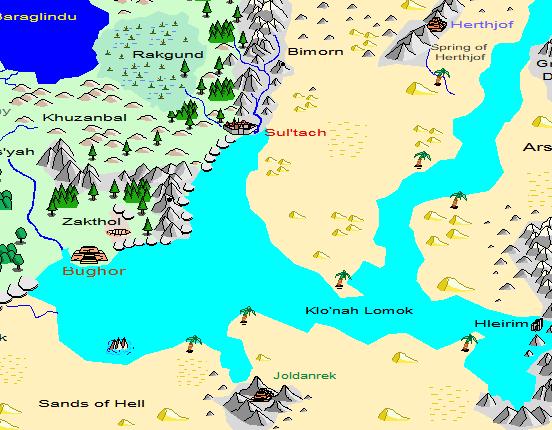
Herthjof was established by merchants from Joldanrek. It was constructed as a marketplace for dealing with those uncomfortable with the region's conditions, primordial sand worms, the Winds of Golruwyrm, and skin-tearing sandstorms. As the settlement grew in importance, the Knudmid assumed administration and security responsibilities. By the eve of the Stone Curse, Herthjof had a population of 20,000 and was recognized as an autonomous city-state. After the Knudmid passed away, with their civilization nearly eradicated by the Stone Curse, governance transitioned to a more democratic model. During the Horgon Era, this shifted to petty dictatorships under Toomrur warlords. By the Second Epoch, the Knudmid had recovered as a people, and under their influence, Herthjof has remained a highly stable republic to the present day.
Situated beneath Herthjof are a dozen subterranean cisterns. Perpetually overflowing, the excess flows through canals, traversing the city and extending into mountain tunnels. An engineering marvel, the spillways constitute a sophisticated water collection system, greatly enhanced by magical devices and rifts. Originating during the Lith-Crilion Era, this ambitious project was undertaken by the Lith-Crillions working from the Pyramid of Life. The goal was to verdantly transform the land east of the city. Around 1000 LE, the Knudmid lost faith in the Lith-Crillions, leading to the cessation of all work on the endeavor. The sole "greening" component completed are the southern mountain tunnels that serve as the headwaters of the Spring of Herthjof.