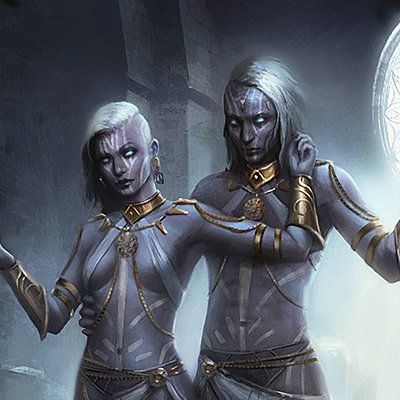
| Category | Races |
| Type | humanoid |
| Creation | 1 Hollow 500 DE |
| Language | Nidurrâb |
| Native | Uth Alok |
Bruh Kreniik established the first Lith-Crillion. These exceptionally gifted individuals were tasked with setting up research outposts on the worlds he had created. They closely observed the rapid evolution of these realms and monitored for any Primordial influences or other disturbances that could disrupt a world's natural development. As a species, the Lith-Crillion were not designed to populate these worlds, but rather to observe and protect them. Their meticulous study of distant worlds and systems was made possible by the Crillion Comet.
On their voyages across the celestial expanse, the Lith-Crillion established outposts on numerous planetary bodies. Those situated on the world of Bal-Kriav are purported to have influenced the surrounding populations, an occurrence they were not intended to facilitate. This is the reason the guardians of knowledge at Nuciregmas designated a historical epoch after them, the Lith-Crillion Era.
In the first year of the era named after them, 1 LE, the Lith-Crillion arrived on Bal-Kriav aboard the living voidship Âni-Zandân, settling on the island Arcana at Urkalzîr. They were able to explore and settle distant regions of Bal-Kriav by utilizing submersibles such as the Âni-Matîrûn and Âni-Nâthil. Later, even these vessels were deemed too sluggish for communication with holds spread across vast distances, prompting them to invent the Pyramids of Power. The exploratory groups that ventured out to survey the realm were known as the Sâlo Tânê.
The Lith-Crillion resided in small settlements, never establishing any centralized authority akin to an empire. Incapable of procreation, their population remained small, never exceeding 100,000 individuals across numerous worlds. They relied on the Birthing Ponds of the Crillion Comet to bolster their numbers. Though few in number, the Lith-Crillion left an indelible mark on several realms. During the early stages of the First Epoch, the Khazarkars of the world Bal-Kriav existed in a fragmented, tribal state. The discovery of a Lith-Crillion relic enabled a shaman leader to learn the Nidurrâb language. Over time, the shamans adopted this as their secret tongue, which then spread to the chieftains of the listening tribes and eventually permeated the masses. The Nidurrâb proved a simpler language to master, and through the persuasive influence of a sentient device, the Old Khazarkar language fell into near-obsolescence.
There are numerous other Lith-Crillion influences and relics of their craftsmanship scattered across the realm. Some of these speak of epic battles between the Lith-Crillion and foes from Chaos. One such clash occurred in 1271 LE, with Lith-Crillion commandos teaming up with a pack of weave spiders to destroy the Womb of Entropy.
In 1465, the Sanguine Whispers uncovered Lith-Crillion tomes within the ancient bastion Ebonstar. They learned that the Lith-Crillion possessed the capability to harness the arcane energies of the Web of Magic. Utilizing the plundered tomes, the Sanguine Whispers then trained a select group in the lost art of web weaving.
On the world of Bal-Kriav, the island of Arcana hosts the greatest concentration of Lith-Crillion ruins. In 1834, the intrepid adventurers known as the Zhut's Explorers investigated two of the island's ancient sites, Felth and Urkalzîr. Within these hallowed halls, they encountered Time Fractures and even claimed to have conversed with Lith-Crillion from a distant era.
The cities of the Lith-Crillion appear to have been centers of learning and research. For instance, the ruined city of Felth had numerous buildings and equipment focused on astronomy, while Urkalzîr contained nature domes that likely served as zoos or enclosures. These guardians, now thousands of years old, primarily protected plant and animal life. Though not directly explored, secondary accounts suggest the existence of a city named Aggda, purported to be a war college and weapons research hub.
Arius, of Zhuts Explorers - "Arcana Expedition"
The Libram of Aggda, a tome discovered within the ruins of Aggda, led some to conclude that the Lith-Crillion were either vanquished by the Saer Erkjorg or compelled to retreat to distant domains. Another hypothesis posits that the birthing pools on the Crillion Comet, the means by which they propagated their species, had ceased to function.
Many claim that the Lith-Crillion are a benign race. However, the fate of the Knudmid and the Stone Curse suggest otherwise. Numerous unanswered questions and mysteries surround the Lith-Crillion, and some believe it is better for this ancient history to remain as such. The Mârukhatâz is one such group that holds this belief, believing the relics and lore of the Lith-Crillion are too great for mortal hands. Conversely, the Mêšodaðûz believe the opposite, possessing the largest collection of Lith-Crillion lore yet sharing it with no one.
The term super region was introduced by the Lith-Crillion. The Lith-Crillion, already highly advanced by the conclusion of their eponymous era, created a series of realm maps encompassing the three super regions of Midrêth, Ninilêth, and Tarôzîr.
Most Lith-Crillion possess a sole name, lacking any family surname. Certain individuals had additional designations attached to their names when employed by one of their multifarious research facilities.
| Trait | Description |
|---|---|
| Status | lost race, considered extinct |
| Bruh Kreniik Seer | +8 intelligence |
| Height | 7' male / 7'3" female |
| Weight | 240lb male / 210lb female |
| Lifespan | 700 years |
Related Information
- Agêrdul
- Aggda
- Bell Tower of Arcana
- Charm of Razalannas
- Crillion Comet
- Crillius-Sarrus
- Dûlan-Nûl Firestorm
- Ebonstar
- Felth
- illithid
- Incubus
- Maziggandîm Conflict
- Mîmêk
- Miradalêth
- Mirundân
- Nithian
- Pyramids of Power
- Reef Ripper
- Sâlo Tânê
- Sands of Hell
- Sarzan'nâth
- SD - Meeting 902
- Stone Curse
- Tolm
- Tubedellâm
- Urkalzîr
- Urla'palos
- Titaram
- Zôd'vîrmâb