| Category | Races | ||||||
| Type | Human sub-race grouping | ||||||
| Creation |
|
||||||
| Language | Nidurrâb | ||||||
| Native | Bal-Kriav |
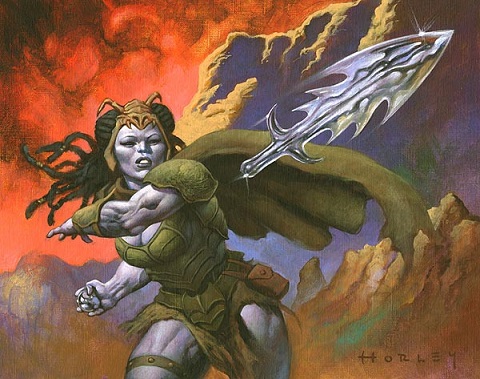
The Khazarkar race is a combination of three distinct human sub-races. Each of the Khazarkar sub-races exhibits a unique coloration, with the Corralum characterized by a deep bronze hue, the Terrant by gray and dark shades, and the Minâth by a light purple tone.
The Khazarkars were illicitly crafted in 260 GE by a Lith-Crillion now known as Set. His objective in creating them was to establish a following, ultimately leading to Ascension. In Otriring, Set implemented regimentation over his creations, with the Minâth served by the Terrant and the Corralum.
Three centuries of Otriring's rule came to a conclusion in 255 LE. Trackers under the command of Danzar-Khâl apprehended the thief, unveiling his unlawfully engineered people who had unfairly benefited from Otriring's conditions. As retribution, Set's environmental transformations in Otriring were to be reversed, rendering the region uninhabitable.
From the perspective of the Higher Powers, the decision to allow 20,000 Khazarkars to remain on the world was a highly debated matter. In the Hall of Edicts, Danzar-Khâl, Athena, and Ares voted in favor of their continued presence on Bal-Kriav. This contrasted with the recommendation of the Sphere Oversight Division, whose models predicted the Khazarkars' temperament could lead to future difficulties.
Driven from Otriring, the Khazarkar commenced the reconstruction of their civilization on the fringes of Klak-tak. Four decades later, on 2 Warper 292 LE, owing to Khazarkar veneration, their progenitor Set ascended into the Temple of Ascension, attaining the status of a Cult Power.
In 1512 HE, the Khazarkars were driven northward by the Hive Swarms ravaging what would later become known as the Hive Region. They passed through Gwaelergoth into the southern tracts of Gulimbor. Over the ensuing three centuries, Khazarkar civilization gradually declined. They regressed into tribes led by family groups, engaged in constant conflict as they competed for resources and numbers. Alliances were forged through strategic marriages, elevating the most influential and powerful families to elite status. Since the era of the Kingdom of Belkazim ( 250 - 275 ) , the Minâth-Nôrî family has wielded considerable sway over the direction of the Khazarkar Empire.
Like the governments of bygone eras, the Minâth are tasked with assigning positions of authority. The Terrant and Corralum possess no voting rights. The Minâth craft the laws and delineate the social customs, which the others must obediently follow or face harsh consequences.
Zibanalêth, a Corralum rebel from Khimilêth - "A Caste Society"
In the First Epoch, the discovery of the Agêrdul, a sentient artifact, precipitated a linguistic transformation. Shamans, the preeminent figures of authority at the time, were the initial adopters of this new language. Over successive generations, they persuaded or compelled the populace to utilize the Nidurrâb tongue. Consequently, their previous language, retrospectively termed Old Khazarkar, largely fell into obscurity after three generations.
In the Gulimbor Cataclysm ( 996 - 1203 ) , the Khazarkars once more commenced their migrations. The majority journeyed northward to the region of Cinazan. There, following a period of internal strife, they established the Second Khazarkar Empire.
Sociology
Khazarkars of the First Khazarkar Empire and the Second, have a haughtiness about them that comes from long indoctrination.Non-Khazarkars are expected to serve the preeminent race and be illuminated to the customs of the virtuous.
Anâth Kazanîr, a renowned sociologist of the Phâte Ubrî, during the Second Epoch - "Superior Beliefs" era
This idea of superior blood resulted in the Khazarkar Purity Edict. Within the Khazarkar Empire, racial purity is both a principle and a law. Half-Khazarkars are ruthlessly hunted down and executed. Even the failure to report one incurs harsh sentences and fines. Though not strictly enforced outside the capital, religious decrees of the Pharzîmrâth prohibit interracial relationships.
All Khazarkars, whether from the imperial types of the Khazarkar Empire or from some island home like Mechantus, possess a trait called Danzar-Khâls Sanction. Bestowed upon the Khazarkars by Danzar-Khâl, it was one of the punishments meted out to Set for theft and use of a rod of creation. This trait affects each Khazarkar caste differently. The Corralum, typically the worker caste, were granted a heightened ability to bluff, or as Lukoon would say, "an advantage when dealing with your superiors"; referring to the Minâth. The Terrants, the soldier caste, were endowed with mental fortitude - to counter deception of the mind. Conversely, the Minâth, sometimes called the vain caste, were dealt a blow, rendered more susceptible to charm.
Khazarkar Castes
There are three breeds, or castes, of Khazarkar. In the Khazarkar Empire, there is a pecking order based on your skin color. The highest caste are purple skinned, the Minâth. The Terrant are those of metallic skin and serve as the warrior caste. The last lot is the bronze-skinned, the Corralum, serving as the worker caste. Outside the Khazarkar Empire, this caste system is not followed. Those of Khimilêth left the empire because of it and the empire's monotheism.Related Information
Tribes
- Bathil
- Tânul
- Tamrazân