| Category | Wars | |||
| Period | 412 - 414 | |||
| Theater | Gulimbor | |||
| Belligerents |
|
|||
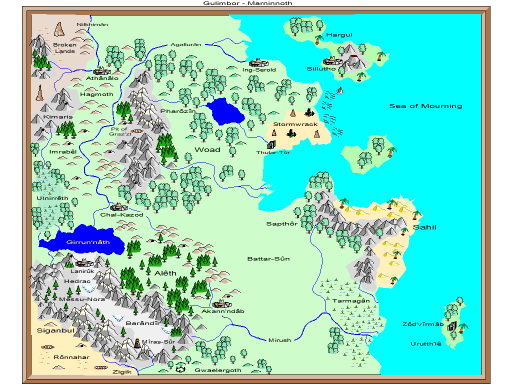
| Map | Marninnoth |
Since the Demon Spawn War, Gulimbor's Imrabêl valley has been the dwelling place of the minotaurs.
These were semi-civilized minotaurs. They were tribal peoples prone to savage behaviors such as raiding and enslavement. They engaged in conflict amongst themselves as often as they plundered the settlements of the humans residing in southern Gulimbor.
Kana-Bran, of Chal-Kazod - "Scout Report: T4-Sector"
By the fourth century of the First Epoch, there were thirteen minotaur tribes. The First Khazarkar Empire was expanding northward from Chal-Kazod, and the minotaurs of Imrabêl lay in the path of the rapidly growing Khazarkar might. For two centuries, the minotaurs raided the frontier settlements of northern Chal-Kazod. There were intermittent periods of peace and prosperity between the belligerents, but these never lasted more than a couple of years before the raiding and skirmishes resumed.
The First Khazarkar Empire initiated this conflict to claim the fertile lands of the Imrabêl valley. The minotaurs constructed their abodes within the cliffs, rendering them highly defensible. They also maintained strategic strongholds dispersed across the mountain paths and hilltops. Their sole disadvantage lay in their chaotic nature, as they engaged in internecine conflict as frequently as they raided the town of Chal-Kazod and its northern villages and homesteads.
The Third Imrabêl War was another in a series of conflicts between the Tragarans, minotaurs, and Khazarkar of Gulimbor. The minotaurs battled to retain control of Imrabêl and repel their northern and southern adversaries, while the Khazarkar strove to subjugate the valley and advance northward, and the Tragarans aimed to establish commercial routes through the valley to the Khazarkar.
At the start of the Third Imrabêl War, there were 10,000 minotaurs in the valley. The Khazarkars initiated the Third Imrabêl War solely for territorial ambitions, not to curb the raiding of the minotaurs as some might have believed. Khazarkar war strategists anticipated that capturing the valley would require less than four months of campaigning. However, the minotaurs' cliff redoubts, fortified underground labyrinths, and mazes prolonged the war for two years. By the war's end, five thousand minotaurs had been pressed into slavery. This slave population consisted more of youths and females than male adults. The minotaurs of "fighting age" were either too proud or stubborn, as very few surrendered even when vastly outnumbered or facing imminent defeat.