| Category | Wars | |||
| Period | 1517 - 1523 | |||
| Theater | Cinazan, Grashakh | |||
| Belligerents |
|
|||
| Maps |
|
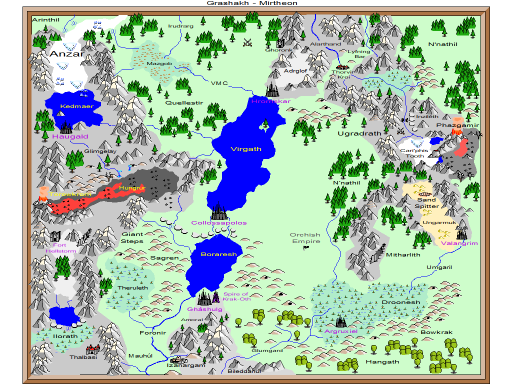
In Dras'ee's War (1517 - 1519), thousands of Fograth soldiers, armed forces of the Orchish Empire, designated themselves as mercenaries, joining the rebel queen and her Hive Army. As a consequence of this indirect assistance to the adversary, the Khazarkar Empire declared war on the Orchish Empire, commencing the Second Ugradrath War.
The Khazarkar Empire launched an assault with four formidable armies, two advancing through the treacherous vale of Lyfning Bar, while the others circumvented the southeastern extremity of Ugradrath, ultimately converging to attack the city of Valangrim.
The Lyfning Bar, the most heavily fortified valley of Brucrumus, impeded the advance of the northern Khazarkar battle group. The Khazarkar generals anticipated this, as it was a diversionary tactic for the primary assault by the southern battle contingent.
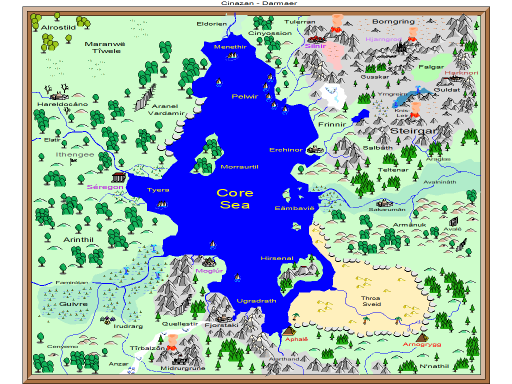
In the final month of 1517, the bustling city of Valangrim was sacked. Garrisoned by the formidable Khazarkar Empire, their forces pushed southward, seizing the grand metropolis of Matak the following year. While ostensibly attempting to reclaim the lost cities, the Orchish Empire dispatched troops through the expansive Tunnels of Ghoronk, assailing the Khazarkar strongholds of Arnogrygg and Aphalê.
The remainder of the war culminated in an oscillating struggle, with Matak sacked on four occasions and Aphalê changing control five times. Accounts describe brutal sieges, during which no living entity above the size of an ant endured the ravages and meager sustenance imposed by the forces garrisoning these cities.
In the year 1523, the Pharzîmrâth, theocracy of the Khazarkar Empire, sought to restore peace. Having endured economic hardship from two prior conflicts, they ratified the Treaty of Aphalê. This accord mandated the return of land and populace to their rightful proprietors.
For the Khazarkar Empire, the true impetus for concluding this war was an assassination. The murder of the reigning Setarch, orchestrated by the Aphallanâth clan, resulted in new leadership focused on economic priorities over continued conflict.