| Category | Forests |
| Continent | Hezmort |
| Region | Zythess |
| Map | Honmin |
Logor, a primeval woodland situated along the northern coasts of Zythess, is renowned for its abundant black oak trees, all said to have been seeded by Silvanus. The local populace has harvested from this ancient forest for millennia. When the Gimrune established their first coastal settlement in the region, black oak became the exclusive timber used in shipbuilding. Logor's druids are acclaimed for their masterful crafting of cudgels and even hammers from the sturdy black oak, which many attest to be as effective as any similar implement forged from iron.
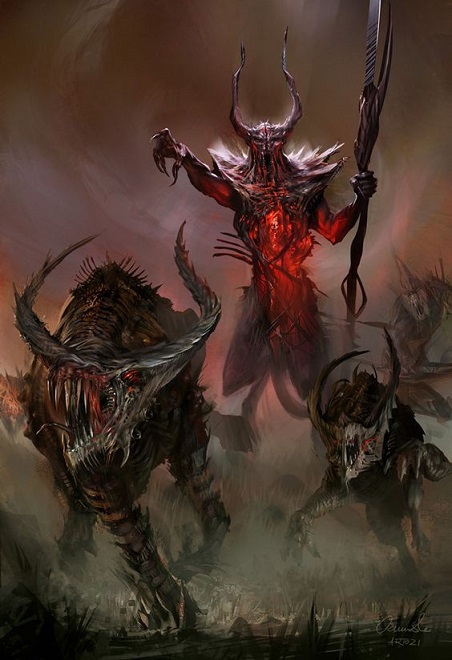
In the God Era, Logor became the site of the Núlananya Rift, a bridge between two realms. Occurring during the Demon Spawn War (89 GE - 269 GE), it became an invasion route for a ravenous demon lord. Bestial legions led by Jurusalax, feral hounds and bar-lgura native to the Abyss, crossed the bridge between worlds, sparking the Zythess Front; a smaller conflict within the Demon Spawn War.
In the year 161 of the God Era, the Covenant general Silvanus successfully closed the Núlananya Rift by extinguishing the life force of the treant known as Núlananya, the source of the rift.
The roots of Núlananya, convoluted and deeply embedded, were severed at the conclusion of the rift. A token from Silvanus to our quarry, in tribute to Núlananya whose creator had been compelled to put it down like a rabid canine.
The High Flagellate Legsnap, addressing the Council of Beasts, proclaimed, "The vines have been cursed"
The "Accursed Vines" referenced in the passage were remnants that broke away from Núlananya's lifeless form. These vines managed to survive, now spreading across the entirety of Logor. The Gimrune, described as "our prey" in the previous text, were the initial pioneers to utilize these Vines of Núlananya in crafting armor, baskets, and even entire dwellings.
After the closing of the Núlananya Rift, Silvanus hunted Jurusalax. The first action he took was to separate Jurusalax from his packs of demon hounds. Once they were apart, he and Silvanus engaged in combat. Jurusalax repeatedly blew upon his horn during the fight, hoping that his most lethal assets, his hounds, would come to his aid. Regrettably for him, his hounds had been lured into chasing Silvanus's sprites and were driven into a frenzy by the euphoric aroma of the flying fey creatures. Jurusalax was slain by Silvanus, and most of his hounds and other minions were subdued, yet some of Jurusalax's rune hound pups managed to survive. Those that now lurk in Logor are descendants of Jurusalax's demon hounds.
The rune hounds of Logor are merely one of the region's perils. Some of the Vines of Núlananya have become corrupted, likely afflicted by chaos taint from the Creation War or the Demon Spawn War. This corruption has transformed them into voracious, highly perilous predators of the woodland.
Along the rugged northern coasts of Logor lies a treacherous area teeming with the nests of hundreds of harpies. These creatures dwell in intricate tree houses, hollowed-out trunks of Logor's black oaks, or cliff caves. Once sprites who served under Silvanus in his campaign to drive back the demons, the harpies were corrupted by the machinations of Jurusalax, the slayer of Callarduran. Jurusalax ordered the capture of Silvanus's sprites, intending to pervert their nature. Rather than going for a quick kill, his minions wasted time trying to trap these quick and elusive creatures. Upon capture, the sprites were subjected to Jurusalax's "special treatment," infused with his own blood while the demon drained theirs. Only five sprites out of a possible hundred survived this demoniac blood transfusion. According to legend, the sprites' blood had an aphrodisiac effect on Jurusalax. The sprites who endured the infusion of demon blood were irrevocably corrupted, transforming into an abomination of their former selves - the fearsome harpies that now haunt the northern coasts of Logor.
Related Information
Notable Resources
- black oak