| Category | Cities | ||||
| Continent | Brucrumus | ||||
| Region | Lands of Purity | ||||
| Owner | independent city-state | ||||
| Population | |||||
| Races |
|
||||
| Deities | Melrith, Tiamat | ||||
| Founded | 4 Temporal 1508 LE | ||||
| Map | Hadraniel |
In the midst of the Lith-Crillion Era, settlers from Loothu'n ventured westward into the Lands of Purity. They were band #22, one of dozens dispatched to carve out a new existence in the wild, establish a settlement, and make a name for themselves, with the hope of becoming another prosperous trade hub like Loothu'n and Baziranâth. The fortunate founders of Hazarâph saw their colony survive where most others had failed. At the time, the population density of the swamplands and the surrounding regions was but a fraction of current levels, perhaps numbering a mere 10,000 humanoids across the entirety of the Lands of Purity. Over the ensuing centuries, Hazarâph blossomed into a major trade center for Ikhen's scaly peoples, often maintaining a stance of neutrality amidst the conflicts of the region, yet profiting from such a posture.
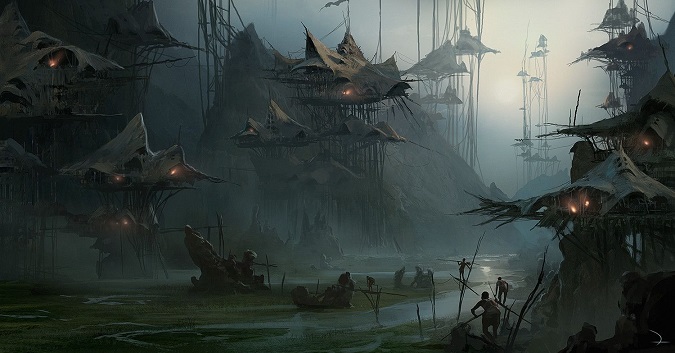
During the reign of the black dragon Ikhenholmbrac, this floating city, buoyed by shambog, was often jokingly referred to as the Sailing Hoard or Ikhen's Barge. However, such mockery was strictly forbidden, as it violated the laws regarding insults against the city's owner. This owner was an ancient black dragon with an acid breath so devastating that it could melt stone. From 879 HE to 1180 HE, Ikhenholmbrac ruled over Hazarâph and the surrounding region for many leagues. Hazarâph was then a much more diverse city, home to yuan-ti, Graagvrii, trolls, and a small Lorhazi population. The Lorhazi were Ikhenholmbrac's favored subjects, receiving the choicest houses and positions. The yuan-ti were distant relatives of those who had founded the city two thousand years earlier. The city also had a slave population, mostly Tungesti from the Urkthal Warrens. As is the case today, this slave population was relatively small, limited by the cost of available space. This space constraint was due to the city's having reached the maximum size for a shambog mass, a condition that has persisted since the reign of Ikhenholmbrac, contributing to the city's high real estate prices.
Hazarâph is a prosperous city, having long maintained this status. It functions as a gateway for goods traversing in all directions around the swamp. Under capable leadership, it acts as a vital trade bridge, facilitating the passage of goods traveling east and west - routes that would otherwise face the perils of Ikhen.
Generally, the populace of Ikhen perceive Hazarâphins as snobbish, privileged individuals who work as financiers, bankers, and members of high society. Most could only fantasize about residing in a locale so secure and where wealth is abundant.
In the Second Epoch, the city's wealthier yuan-ti, backed by the Merchant League, covertly pooled their resources. They purchased the properties of other racial groups, and when someone refused to sell, they resorted to coercion. This entire operation, code-named the Hazarâph Shuffle, was a Merchant League strategy to impede Hazarâph's expansion. It was one of several schemes implemented across the lands, with the Merchant League aiming to amass influence and prosperity at the expense of their neighbors. As Hazarâph's population plummeted due to evictions and buyouts, a run on the banks ensued. This, in turn, bolstered Paradomea City, making it the safest place to store one's wealth, a title long held by Hazarâph.