| Category | Empires | ||||||||||||||||
| World | Bal-Kriav | ||||||||||||||||
| Region | Miradelgûn | ||||||||||||||||
| Government | Republic | ||||||||||||||||
| Capital | Skulfdar | ||||||||||||||||
| Population | |||||||||||||||||
| Races |
|
||||||||||||||||
| Alignment | non-good | ||||||||||||||||
| Deities | Poseidon, Talos | ||||||||||||||||
| Enemies | |||||||||||||||||
| Established | 26 Temporal 1111 | ||||||||||||||||
| Map | Gunaegail |
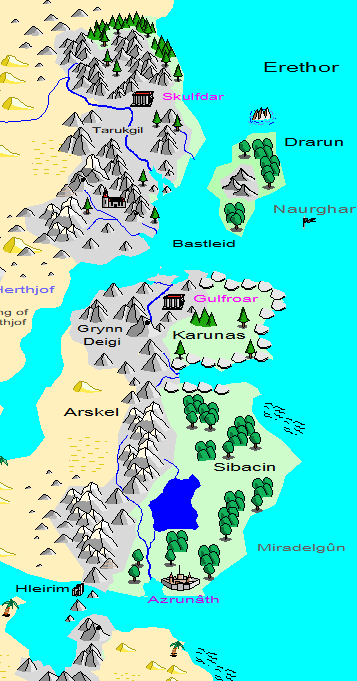
The Naurghar republic was founded by the storm giants of the Bay of Bastleid. These giants had been residing along the aforementioned bay since the Dawn Era, with nearly all of them claiming heritage from soldiers who served under Talos in the Creation War. Before becoming an empire, they were a free-booting people who preyed on the coastal settlements and ships of Erethor. When encountering another ship, the target could pay them not to attack - "the Bastleid Toll" - or suffer an attack by a longship of storm giants. These ships and their crews were easily a match for most vessels they encountered. Prior to the rise of the Khazarkar Empire and Shounejo, they were the most feared group in Gunaegail. They challenged small independent holds and even those under the flag of the largest and mightiest naval powers of Midrêth. For as long as anyone can remember, Bastleid's giants had been demanding tolls for passage of Erethor - you either paid the toll or suffered attacks on your shipping and raids on coastal settlements. This practice began to end with an agreement among the regional powers, except Naurghar, called the Bastleid Trade Act. In simple terms, this treaty stated that no power could charge tolls on the open seas and that each signing nation could claim up to ten miles of sea from their coastal settlements as territory. The Khazarkar Empire, Shounejo, and others enforced this act by a blockade of Bastleid, which sparked a war that led to the sacking of many storm giant holds. The giants were defeated for a time, but out of this defeat was born the Naurghar empire. They unified their towns and cities solely to meet the rising power of Erethor's younger nations.
The Bastleid Trade Act concluded the Bastleid Toll, yet did not curb the giants' propensity for piracy. For many residing along the Bastleid Bay, piracy served as a livelihood. This practice facilitated a reasonable redistribution of resources - "empires like Zeymah'kein (600 HE - 1600 HE) and Mir'piamauza contributed a portion of their substantial affluence to the indigent."
Some of Bastleid's storm giants had the distinction of earning their pirate's beret through a game of chance. This occurred when a Gradorian pirate, the former naval commander of the Mir'piamauza navy, hired four storm giants as his crew. This was done out of necessity, as he required their assistance to crew a recently won prize - a sailing ship built to accommodate the great size of giants. The ship was destined for Kel'gah to be scrapped, but fate intervened, and they encountered a perilous situation along the coasts of Arghild. In this dangerous area plagued by pirates, the storm giants proved invaluable in an engagement with three pirate ships, sinking one, capturing another, and sending the third fleeing. Thus began the history of giant pirates. They could often stand their ground against several pirate ships, and a single ship often surrendered rather than be pulverized by the giants' boulders and lightning bolts, which would make many arcanists tremble. When their captain was lost in a storm, the crew continued to pirate, and over time, they were joined by others. The wealth and tales of high adventure led to generations of Bastleid's storm giants taking up the trade of freebooters.
The storm giants of Bastleid have suffered setbacks and even been brought to the brink of ruin due to reprisals by the greatest empires of Erethor. Their coastal settlements have been assaulted and razed, and their naval forces vanquished by the likes of the Khazarkar Empire and city-states such as Azrunâth, yet the efforts to eradicate them from their sea cave strongholds and fjord fortresses have consistently culminated in disaster.
An assault on the Naurghar is typically achieved by gaining naval supremacy in the Bastleid bay and then dispatching troop transport ships. Once ashore, the forces must endure heavy bombardment and missile fire from storm giants and whatever additional forces they possess. Over the following hours, the skies will darken with ominous clouds, and the rains will commence, accompanied by lightning strikes that can shear masts, followed by powerful winds. This tumultuous weather is generated by clusters of druidic storm giants. The storm subsides several days later, leaving any ships unable to depart wrecked along the coasts, sunk, with masts and rigging lost, rendering them unfit for the seas. During this storm, the ground forces are attacked by the Naurghar and their minions, unable to receive support, shore bombardment, or evacuate the wounded. After the storm, the ground forces are typically scattered amidst a maze of fortifications and trenches that extend approximately a hundred feet back from the coastline, encircling the enemy settlements and strongholds. Those attempting to navigate the tops of these trenches come under heavy missile fire from giants who hurl lightning bolts and boulders charged with electricity. The effects of these attacks in the wet, flooded terrain are devastating, likely proving fatal to any who sustain a direct hit. Overcoming these defenses requires a protracted siege, utilizing bridging equipment to span the trenches, backfilling, and employing hardened mantlets capable of withstanding the impact of giant-sized boulders. These mantlets are cumbersome and require the efforts of a heavy catapult crew to maneuver. Despite these challenges, punitive expeditions against the Naurghar continue, though the costs often outweigh the benefits of simply paying them off.
Nâmar-Nathân, Githân naval historian - "Engaging the Naurghar"
Naurghar rose to the status of an empire during the Second Epoch. The formation of the empire stemmed from a strategic maneuver with the voting process, where each settlement cast ballots based on population size. While a two-thirds majority was required for centralization, the expectation was for a split decision, preserving the decentralized rule of Bastleid's holds under petty governors. However, the storm giants seeking unification secretly freed their slaves and bonded-men, legally granting them citizenship within their holds. This influx of new citizenry ultimately resulted in the unification and the birth of the Naurghar empire. The process also led to the establishment of a culturally diverse population, with Shou, Khazarkars, kobolds, and non-giants acquiring citizenship.
Naurghar's population has expanded, with former hostages gaining liberty by paying off their masters, those freed for exemplary service, and outsiders arriving in Bastleid and its Naurghar pirate towns in pursuit of wealth and renown.
The formation of the empire has not curtailed their pirate tradition, resulting in other states alleging that they are supporting these activities.
The people of Naurghar steadfastly maintain their longstanding tradition of imposing maritime tolls upon foreign ships, coupled with the requisite acts of piracy and pillaging to ensure the collection of outstanding debts.
Phoslomor, the renowned cartographer of the Third Epoch, excerpt from the "Survey of Midrêth, Chapter 13"
Holdings
- Gulfroar
- Skulfdar
| Skulfdar | |
| Naurghar |