| Category | Cities | ||||||||||
| Continent | Brucrumus | ||||||||||
| Region | High Wood Country | ||||||||||
| Owner | independent city-state | ||||||||||
| Government | Blighted Council | ||||||||||
| Population | |||||||||||
| Races |
|
||||||||||
| Deities | Gruumsh, Krak-Oth, Melrith | ||||||||||
| Founded | 19 Witchrite 846 HE | ||||||||||
| Map | Ohtarion |
When Maglubiyet fell silent, numerous goblin assemblages construed that stillness as abandonment. One such troop—their ardent clerics imploring martial examinations—migrated northward into the High Wood Country in pursuit of atonement through competence. Some adopted the veneration of Gruumsh and other martial patrons, persuaded that martial dedication could reclaim celestial favor.
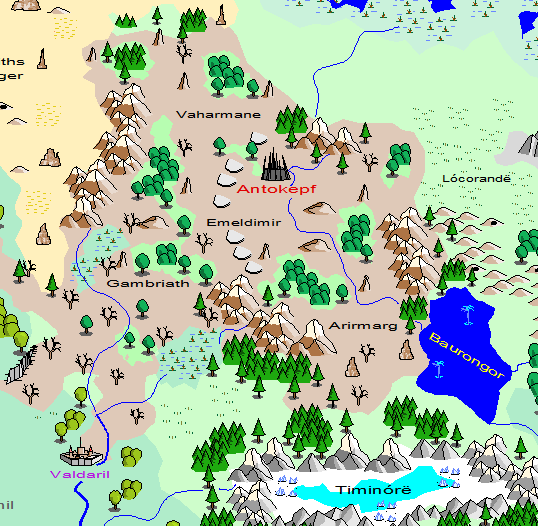
Guided by their devoted clergy, the migrants ventured into the obscured valley of Emeldimir, where they collided with sprites of Gambriath, malicious fey, and tainted treants before establishing Antokepf at the convergence of a lush glade and a withered forest.
For centuries the Yúghít clan presided over the city until civic authority transitioned on 19 Kindle 1880 HE, when the Blighted Council assumed governance and guided Antokepf through a new era of statecraft and ritual.
The city's liturgy now interlaces the worship of Gruumsh, Krak-Oth, and Melrith. Krak-Oth gained an increased following during the Horgon Era due to proselytizing by Theegan missionaries from Ak'mrîtun, while Melrith's influence expanded with the ascendancy of Emeldimir's shadowy forests—Arirmarg, Gambriath, and the Vaharmane.
The architecture of Antokepf reflects its dual nature: Theegan domes and goblin spires rise amidst gardens where druids nurture the swift cycles of decay and renewal, a living paradox of rot and bloom nurtured within the city's folds.