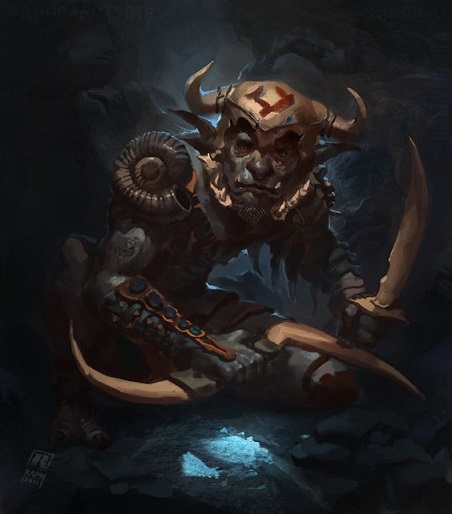
| Category | Higher Powers | ||||
| Power | Lesser | ||||
| World | Avalas | ||||
| Race | Goblin | ||||
| Gender | male | ||||
| Alignment | neutral evil | ||||
| Symbol | red pincer | ||||
| Domain | Chaos, Destruction, Trickery, Tyranny | ||||
| Enemies | Gruumsh | ||||
| Born | 6 Warper 70 GE | ||||
| Godhood | 3 Witchrite 621 LE | ||||
| Died |
|
In the God Era, the worlds of the Mortal Systems were invaded by demons. This Demon Spawn War had two main factions, one of demon lords and the other serving the Quara'tun Covenant. Maglubiyet, a mercenary general, served whichever side best suited him and his goblin people. He devised the strategy of creating numerous mercenary units, which he would lend to any force in need of soldiers. Maglubiyet's aim was to scatter the goblins across the lands, positioning them well among the civilizations once the chaotic war ended. One such example is the goblins who came to inhabit Bowkrak and Hangath. They were part of a 20,000-strong army searching for a side to join. In the dark waters of Droonesh, they found themselves caught between two demon armies. Maglubiyet dispatched envoys to negotiate the highest price for his army, but there was insufficient time to determine their allegiance or complete the bargaining process. Maglubiyet's personal chronicler recorded the events.
One army served Demogorgon and the other Baphomet. Their demon generals, far removed from their overlords, exercised a near-autonomous decision-making authority. Our envoys, unfortunately, never returned. A demon sergeant or captain, upon spotting the colors of their hated adversary, swiftly ordered an attack. Demons, as a rule, prove challenging to command and control unless a powerful demon lord is in close proximity.
Maglubiyet favored the notion of overpowering numbers, yet disliked the concept of a lowly soldier determining when to confront the adversary.
Mashur Gúm, the Second Chronicler to Maglubiyet, - "Droonesh, Lost Armies Three"
In the Lith-Crillion Era, Maglubiyet was a renowned goblin hero, a champion of his people. Similar to the orc hero Gruumsh, he traversed the lands waging war, uniting goblin tribes, and decimating others. Living far beyond a typical goblin's lifespan, Maglubiyet extended his existence by forging pacts with various demon lords. One he frequently interacted with was Graz'zt. Approximately every half century, this demon lord dispatched a Lifestealer succubus to his most esteemed mortal ally. There, Maglubiyet would absorb the succubus's powers, his mortal form rejuvenated, his longevity prolonged at the expense of hundreds of lives. Though a gruesome affair, Maglubiyet's followers, and later the masses of his empire, viewed it as a necessary means to keep their revered leader alive.
In 272 LE, Maglubiyet led an army of tens of thousands from Kriav to Avalas. Reaching this world was no easy task, requiring a battle and the manipulation of chance. As a warmonger, the first was easily accomplished by Maglubiyet, but the second necessitated outside assistance. Graz'zt considered enlisting Lukoon's help, but realized that he remained too closely aligned with the Covenant's righteous elements. Graz'zt, the strategic mastermind behind Maglubiyet's conquests, sought out a being capable of manipulating time, one who could transform chance into a fixed point. He made a deal with Chronos, surrendering his favorite succubus harem to one who occasionally alters the flow of time for personal gain. In turn, Chronos modified the Avalas War Call from a random time and world to a random world alone. With this, all Maglubiyet had to do was initiate a battle at a predetermined moment and wait for chance to converge upon his instigated conflict. It took fifteen battles and two years for the Avalas War Call to fixate on one of Maglubiyet's engineered confrontations.
The conflict came to a close, and we emerged victorious. The heavens illuminated with brilliant flashes, and a thick mist ascended from the gore-stained terrain. The cacophony of combat reverberated from the distance. Maglubiyet commanded his legions to advance, entering the war-ravaged dominion of Avalas.
Marz Bulfish, the 18th Chronicler to Maglubiyet - "Into Battlefields Eternal"
Over the ensuing three centuries, Maglubiyet forged a sprawling goblin empire that encompassed continents, islands, and even subsurface realms. In doing so, his legions demolished demonic idols and shrines devoted to Orcus, a longstanding adversary of Graz'zt.
Maglubiyet's final mortal demise occurred on the 8th of Kindle in the year 594 LE. Instead of the gentle yet sinister embrace of one of Graz'zt's succubi, which would have granted him continued longevity, Maglubiyet was withered to dust. He had reached the limit of the succubus's arcane powers. Maglubiyet's death precipitated a civil war that seemed interminable. It shattered the Gob'biyet Empire into warring city-states. To end the protracted conflict, Maglubiyet was deified. On the 3rd of Witchrite in the year 621 LE, he was elevated to the pantheon as the patron deity of the goblin race. Those responsible for his admission to the Higher Powers hoped this would foster a measure of unity and civilization among the goblins. As a Higher Power, Maglubiyet rebuilt his dominion. No longer needing Graz'zt's assistance, he severed ties with the demon lord and his ilk.
In the Horgon Era, the orc warlord Gruumsh led a great army to Avalas. He launched an assault on Maglubiyet's empire, determined to overthrow its leader and seize his divine power. Overseeing Gruumsh's military intelligence was a Lith-Crillion named Blac'drugulois, who would one day create the mightiest orc empire in Bal-Kriav. Gruumsh spearheaded a perilous surgical strike against the head of goblin leadership, a god no less. Maglubiyet, considering a mortal no serious threat, was caught off guard. On 21 Hollow 588 HE, the mortal Gruumsh killed the god Maglubiyet. With Maglubiyet's demise, Gruumsh ascended to become a Higher Power through conquest. Centuries of devotion to one god were now redirected to another, as Maglubiyet's guiding principle of "Might Makes Right" facilitated a relatively smooth transition from one divine ruler to the next.