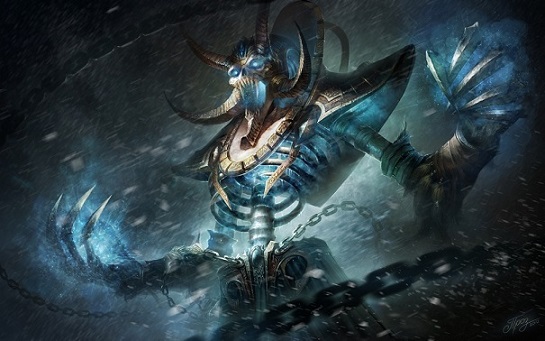
| Category | Higher Powers |
| Power | Minor |
| World | Dol Vahdin ( Tartarus ) |
| Race | Durkoth (Lich) |
| Gender | male |
| Alignment | chaotic evil |
| Symbol | melting demoniac skull with dagger in jaws |
| Domain | Chaos, Destruction, War |
| Born | 28 Bliss 2821 LE |
| Godhood | 17 War March 1288 HE |
In 862 HE, four Helas Vessels from the world Osâchar arrived on the world Bal-Kriav. Aboard one of these vessels was the then mortal Krak-Oth, one of three Saints of Maen who came to Bal-Kriav during the Horgon Era. His Helas Vessel is now known as the Spire of Krak-Oth. In Bal-Kriav's Grashakh region, his people founded the Ak'mrîtun Empire. One of his most powerful lieutenants was the Durkoth Orthraak. As the empire expanded into the Tribe Steppes, this underling controlled the lands around Argruxiel while Krak-Oth ruled from Binê Sadôr.
Between 1100 HE and 1200 HE, Ak'mrîtun's Durkoth began departing for the seas. They were joining other Durkoth across Midrêth in what would become known as the Durkoth Descent (995 HE - 1355 HE). The Durkoth under Krak-Oth ventured into the Underdark, where they gained mastery over the aboleth of Cthorgo and the Green Nebulous. The Theegan people back on the surface were left to fend for themselves.
On 17 War March 1288 HE, the Gray Block underwent the draining process of Ascension, elevating Krak-Oth to the status of a Cult Power. The initial worshippers of Krak-Oth were the inhabitants of Ak'mrîtun.
Many generations had known Krak-Oth solely as the leader. He was deeply revered on his ancestral homeworld, and for a protracted period, esteemed by those under his command on Bal-Kriav. In the initial stages, it was his Torc of Maen Grirngrim that rendered him omniscient to the populace. A century into Ak'mrîtun's reign, centuries of governance and advisory, had transformed him into an authoritarian, yet efficient sovereign.
When the Durkoth withdrew to dwell in the deeps, the Theegans' millennia of servitude finally reached its conclusion. While some would continue to venerate the Durkoth, others would redirect their devotion to alternative deities.
Cathandril, hailing from the Religions of Chaos - "Krak-Oth's Flock"
Early in the First Epoch, some of Krak-Oth's Theegan followers abandoned their reverence for him and instead worshipped horses. On 11 Bloom 43, Krak-Oth leveraged the power of his Torc of Maen Grirngrim, although this action nearly shattered and permanently weakened the artifact. The horse cultists were then cursed to rise the following day as a novel race of creatures known as the Jara - these centaur abominations, driven by destruction and war, accelerated the downfall of the Ak'mrîtun Empire.
Following Krak-Oth's ascendance to divinity, his missionaries promulgated his faith. Dozens of gnoll tribes in the Northern Hordelands fell under the sway of his gospel. By the time of Ak'mrîtun's collapse, the gnolls of this region maintained a robust priesthood devoted to Krak-Oth. Gnoll veneration of this deity coincided with the worship of other sinister gods during the era of the Drugnod Dynasty, and its successor realms Yagamph and Garormuk.
Krak-Oth's influence in the super region Midrêth waxed and waned over time. It picked up again with the rise of the Ningizzida empire. In 1305, yuan-ti priests of this empire commenced spreading the word of Krak-Oth to the Council of Bile. This empire of Hells Womb welcomed another War God as a counterweight to the occasionally overbearing influence of the Church of Ares.
In the 1500s, the worshipper base of Krak-Oth grew substantially within the Altocumuli empire. This occurred due to a potent disinformation campaign initiated early during the War of the Fragments.
| Core Worship | Proselytizers |
|---|---|
| Antokepf | Entropic Guard |
| Altocumuli | Entropy |
| Council of Bile | Sanusanâchâr |
| Garormuk | |
| Ningizzida | |
| Yastorogg |