| Category | Regions | ||
| World | Bal-Kriav | ||
| Continent | Brucrumus | ||
| Climate | temperate | ||
| Maps |
|
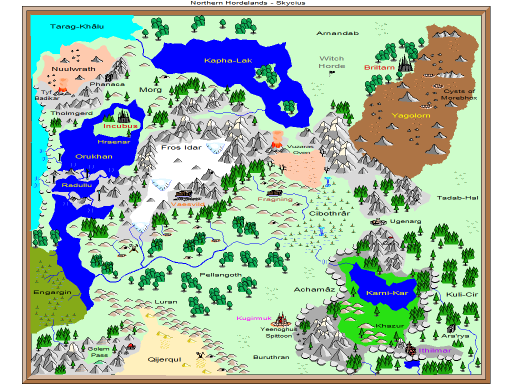
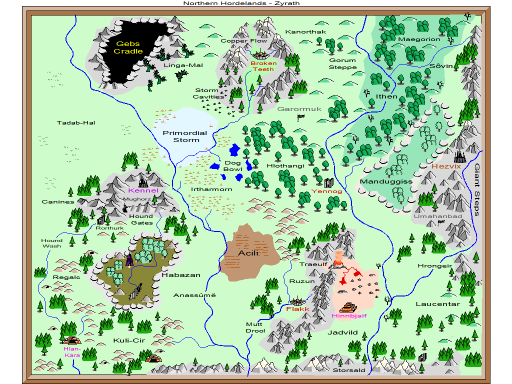
The Northern Hordelands comprise an expansive landscape characterized by a diverse terrain, featuring sweeping plains interspersed with undulating hills, serene lakes, towering mountain clusters, elevated plateaus, and deep depressions. The weather patterns of this region are notably erratic and often turbulent, a direct consequence of the ever-present Primordial Storm at the heart of the area. This incessant atmospheric disturbance also gives rise to the abundant presence of elementals throughout the Hordelands.
The untamed and wild peoples of the Northern Hordelands have stubbornly resisted subjugation by their more advanced or powerful neighbors. The Jara Hordes under their malevolent khans have raided the lands, yet failed to secure any lasting dominion. The legions of the Orchish Empire have marched in and then been driven out after substantial losses. The elves of the High Wood Country have attempted to extend their territorial buffer, only to witness the barbarians of the Northern Hordelands devastate the surrounding forests.
For countless centuries, this region situated north of the Lands of Purity was inhabited by tumultuous populations. The barbarians of the land encompassed the Theegans, gnolls, jara, and disparate bands of humanoids. The introduction of sig-lorms to the southeastern corner of the Northern Hordelands lent a degree of organization. Regrettably, their nation was fleeting.
In the Second Epoch, a delicate balance of power spanned much of the Northern Hordelands. The foundation of this equilibrium was the Sig-Lorm of Hinnbjalf, who disseminated both intellectual and entertainment-based enlightenment. However, when Hinnbjalf fell victim to a volcanic eruption, becoming the domain of fiery extraterrestrials, the region's ancient traditions of raiding and strife reemerged with unrelenting ferocity.
In the Third Epoch, the Luran Alliance, supported by Nordern, expanded into regions long associated with the Witch Horde. This was a wild and lawless territory spanning the Buruthran Plain and the Luran Hills. During the Buruthran War (1824 - 1829), the Witch Horde was pushed further northward. The lands that came under the control of the nascent Divine Empire became new, relatively secure trade routes all the way to Kugirmuk.
The Theegans, though a crude and barbaric populace, will undoubtedly experience a gradual attenuation of these tendencies as they become integrated into a lawful society over successive generations.
Crusader Lanunur, "Records from Internment Camp 6"
The lands of the Northern Hordelands boast an exceptionally vast equine population, numbering in the hundreds of thousands. It is widely believed that the horse count in the region exceeds that of the humanoid inhabitants. During periods of armed conflict, the Theegans, renowned for their exceptional equestrian abilities, are highly coveted as mercenary forces.
The Underdark region beneath the Northern Hordelands is referred to as Phangul.
|
|
| City 12 | Founded | Elevation |
|---|---|---|
| Hinnbjalf | 115 GE | 2,500' |
| Hezvix | 138 GE | 5,000' |
| Hlan-Kara | 152 GE | 3,000' |
| Kennel | 159 GE | 6,000' |
| Incubus | 331 LE | 4,000' |
| Fragning | 22 | 2,600' |
| Briltarn | 60 | 1,550' |
| Vaesvild | 217 | 7,800' |
| Kugirmuk | 602 | 400' |
| Broken Teeth | 612 | 3,200' |
| Ithilmar | 743 | 3,700' |
| Flakk | 842 | 4,400' |