| Category | Races |
| Type | medium humanoid |
| Creation | 11 Lunar 1712 DE |
| Language | Langurâpha |
| Native | Osâchar, Bal-Kriav |
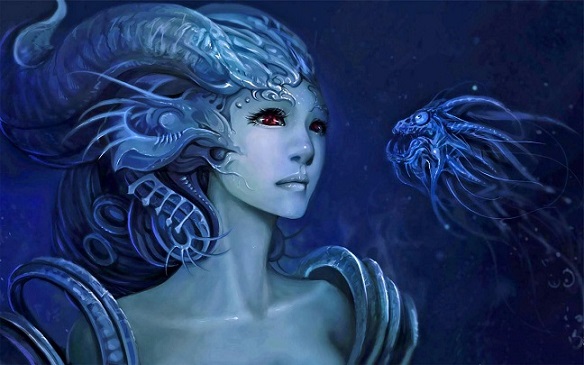
The Durkoth originated as an aquatic populace on the world of Osâchar. Once a watery domain, they were crafted by Sathel, safeguarding against the forces of Chaos.
In the Creation War, Osâchar became a battlefield where the primordials and the Nawirrûs Covenant engaged in fierce combat. The Durkoth, like many others, joined the fight to preserve the works of Creation. Osâchar underwent dramatic transformations, infused and torn by conduits to Chaos, resulting in a landscape dominated by land with only vast lakes the size of continents remaining of the once-great seas. Sathel ensured the survival of her Durkoth creations by mutating them to thrive better on land than in the seas.
In the Demon Spawn War ( 89 GE - 269 GE ) , the Durkoth were held in reserve. They would be deployed if the demons escaped the Quara'tun System and assailed worlds like Osâchar; a planet of the Asteraoth System.
In the Lith-Crillion Era, the Durkoth warred over three ancient relics known as the Torcs of Maen Grirngrim. These artifacts possessed immense power, granting their wearers incredible resilience. The last of the thirteen Torc Wars saw the rise of the Horgon Empire in ( 159 HE ) . This empire, led by a confederacy of near-omnipotent beings known as the Saints of Maen, consolidated its power and proceeded to subjugate the surrounding peoples, including the Theegans, Sussgurd, and the Dromites. These conquered nations were reduced to laboring as workers and slave soldiers, with the Durkoth employing chaos archons to maintain control over the subjugated populations, particularly the Hydrocur and the Laupha.
In 430 HE, Osâchar was confronted by a massive illithid invasion. The Second Suellk Invasion ( 430 HE - 537 HE ) commenced as simple raiding but later escalated into a full-fledged occupation. Under the oppressive rule of the illithids, the people of Osâchar soon realized their grim fate - to serve as sustenance for their cerebral captors.
Faced with the imminent threat of annihilation, or worse - an illithid's culinary indulgence, the Durkoth undertook a massive evacuation of their home world. In 537 HE, thousands of them and even more of their subordinates escaped their beleaguered world aboard colossal arks known as the Helas Vessels. These ships transported their complement across the expansive Void to the world of Bal-Kriav. In 862 HE, the travelers emerged from their hibernation. The Helas Vessels then commenced their descent, each landing in remote, disparate locations.
The Durkoth founded numerous colonies on Bal-Kriav. They exerted dominion over the surrounding populace. Their advanced technology, as well as their arcane and psionic proficiencies, frequently surpassed those of the tribal communities in the region. The empires they established and presided over are enumerated in the table below.
During the Durkoth Descent ( 995 HE - 1355 HE ) , many Durkoth mutated, reverting to their aquatic origins. The mutating ones were known as The Chosen , ardent believers in the near-divine status of their leaders, whom they revered. These leaders, the Saints of Maen, were the same individuals who had ruled them on Osâchar and now led them on Bal-Kriav. Legend recounts that the Chosen followed their masters into the seas, while those who did not were left to perish, becoming the Forsaken . As more Durkoth departed for the oceans, the Forsaken grew increasingly vulnerable, many hunted down by their former slaves. During the Durkoth Hibernation ( 1355 HE - 1555 HE ) , the Forsaken eventually died out.
In the depths of the seas, the Chosen constructed new empires and city-states. They dominated those around them, enslaving them and compelling them to build grand cities. It was during this subaquatic empire-building that the Saints of Maen Ascended to divinity. Their former subordinates became their celestial devotees. The underwater city-states became smaller versions of the empires that once thrived on the surface. These were governed by monotheistic theocratic regimes that paid homage to the Horgon founders - Krak-Oth, Neld-Rac, and Rioch Tetrax.
| Spire Landing Sites | Post Durkoth Descent | |||
|---|---|---|---|---|
| Spire | Map | Population Centers | Durkoth Descent Destination | Population Centers |
| Spire of Krak-Oth | Mirtheon | Argruxiel | Cthorgo | Titaram (as slaves) |
| Sava'loth | Binê Sadôr | Green Nebulous | Urla'palos | |
| Spire of Molakh-Búle | Nithlurik | Abâthigûr | Zen'nêlkhush | unknown |
| Cinduk | Râpha-Sûn | Tyelcirion | Inendeep | |
| Spire of Neld-Rac | Hiznaar Goz | Spire of Neld-Rac | Rângilan | Limac-Nîr |
| Spire of Rioch Tetrax | Chengom | Nagdúrzol | Orat-Khagor | Ogharkú |
| Trait | Description |
|---|---|
| Status | lost race, considered extinct |
| Superior Intellect | +5 intelligence |
| Psionic Receptacle | start with 5 psionic power points which are only useful if they can manifest psionic powers |
| Lifespan | 400 years |