| Category | Wars | |||
| Period | 1694 - 1697 | |||
| Theater | Azrik | |||
| Belligerents |
|
|||
| Map | Vetoubahr |
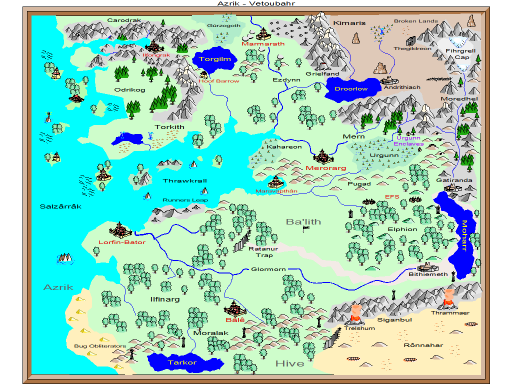
As Raxcvillibus advanced southward, additional Ba'lith generals joined his burgeoning forces. This catalyzed a schism within the empire, with certain factions aligning with the Church of Coeus (the reigning ecclesiastical authorities of Ba'lith's theocratic government) and others supporting the invader.
In Warper 1695, following the advice of Asmodeus, "If Coeus is removed, you will have the Right of Victory", Raxcvillibus and his team traveled to the world Dol Vahdin and eliminated the demigod Coeus. Given Coeus's immense size, Raxcvillibus brought the god's severed head back in a wagon. The priests of Coeus were the first to confront the ramifications of their deity's demise. They lost all future access to divine energy from this god, rendering them incapable of casting spells, and worse, leaving them without a guiding divinity. Some of the minotaur priests approached Raxcvillibus, acknowledging that if he could slay a god, then he must be near-divine himself, "for only a god can kill another god". After further confirmation of Raxcvillibus's involvement in Coeus's death, they pledged their loyalty to him as their new leader.
In the resulting conflict, Raxcvillibus's armies assaulted the temples of Coeus, mercilessly slaughtering priests and worshippers. This purge of Coeus's priesthood and follower base persisted for four years, ultimately eliminating the Church of Coeus. That same year he killed a deity, Raxcvillibus ascended as emperor of Ba'lith, ushering in a religious conversion that eradicated the final remnants of Coeus and propagated the doctrines of the Church of Asmodeus.
Across Azrik, the clergy of Coeus was decimated. Certain fanatical groups retreated to the mountains, swamps, and other remote locales, temporarily waging guerrilla campaigns. The city of Bithiemeth served as the backbone of resistance against Raxcvillibus's newfound dominion. The settlement succumbed after a protracted three-month siege. The majority of the defenders perished from a virulent illness propagated by Borurthane operatives.