| Category | Empires | ||||||||||||||||||||
| World | Bal-Kriav | ||||||||||||||||||||
| Region | Azrik, Pipe Home | ||||||||||||||||||||
| Government | Klomtroller | ||||||||||||||||||||
| Capital |
|
||||||||||||||||||||
| Population | |||||||||||||||||||||
| Races |
|
||||||||||||||||||||
| Deity | Asmodeus | ||||||||||||||||||||
| Enemies | Deep Six, Giff Leaque, Ivory Asylum, Vîlnên | ||||||||||||||||||||
| Ruler | Emperor Raxcvillibus, Empress Katrana | ||||||||||||||||||||
| Established | 14 Warper 817 | ||||||||||||||||||||
| Maps |
|
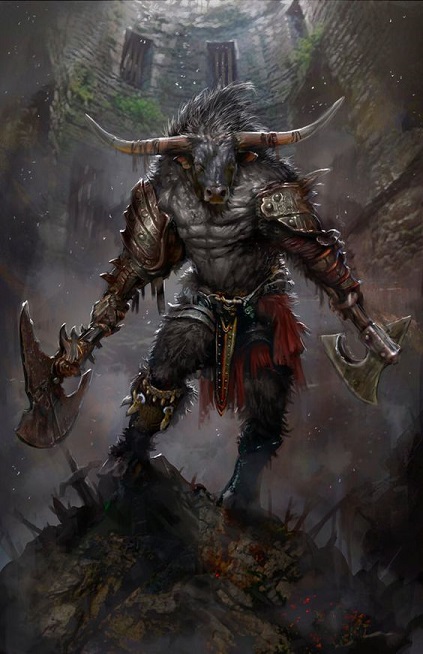
The mighty Ba'lith Empire hails from the storied Azrik Region. Its Minotaur founders trace their origins to the cliff villages nestled five hundred miles eastward, within the Imrabêl Valley. However, the Minotaurs grappled with internal strife as much as the encroaching hordes of Tragarans and Khazarkars pressing in from all sides.
In the Third Imrabêl War ( 412 - 414) , the first incarnation of the Khazarkar Empire conquered Imrabêl's minotaurs. Viewed as brutish and extremely chaotic, their Khazarkar overlords set about remaking them. Over several generations, the Khazarkars selectively bred the minotaurs, retaining only those with an Energy Composition of less entropic tendencies. These measures, not unprecedented, were codified in the Minotaur Cultural Edict ( 420 - 796 ) . This proved remarkably successful, effectively quelling the often violent nature of the minotaurs - what the Department of Retooling termed "demon origins, these sons and daughters of Baphomet."
Under the dominion of Khazarkar overlords, with their seat in Gulimbor, Imrabêl's minotaurs underwent rigorous training and instruction in disciplines where they demonstrated the greatest aptitude. Subservient personnel who exhibited unwavering loyalty and competence were granted the privilege of temporary respite and the liberty to wander freely for several lunar cycles.
The armorsmiths and weaponsmiths of our people were in high demand. In certain communities, a minotaur blacksmith was regarded as the settlement's preeminent producer of arms and armor.
Thirak Imgirthim, a renowned minotaur historian of the Second Epoch
For the next three centuries, there were 25 periods of slave unrest. In the year 731, the 15th Khazarkar Uprising significantly depleted the crown's treasury. The Khazarkars were hemorrhaging funds due to labor strikes and general civil disturbances. The most rebellious contingent comprised the minotaurs, who protested for greater liberty and an end to the practice of trimming their horns, which they decried as humiliating and an outdated measure of the MCE. The minotaurs proclaimed themselves a productive element of society, asserting that their demonic inclinations were long vanquished and that they posed no threat. Many minotaurs even viewed their masters as bosses and even friends.
In the year 750, a prominent minotaur named Ba'lith assumed leadership of the minotaur resistance movement. He orchestrated a widespread uprising across the Khazarkar Empire. Though they knew they could not defeat their masters' armies outright, they aimed to strain the empire's economy and force them to negotiate. A covert arms buildup commenced with the assistance of the Vorjunts. Minotaurs also grew more inclined towards arena fighting and serving as mercenaries for various Khazarkar lords, a notable shift from previous norms. In 762, a Cal-Thaounean they nicknamed "Leghorn the Human" entered the minotaur's story. This accomplished alchemist devised a solution to harden minotaur horns, making them exceedingly difficult to trim. Leghorn's herbal concoction, used to strengthen exoskeletons and bony structures like teeth and horns, remains in use to this day.
On 12 War March 785, a long-simmering unrest exploded in the Great Minotaur Revolt ( 785 - 796 ) . Nearly the entire minotaur slave population rose up against their masters. Over the subsequent decade, a prolonged and bloody conflict ensued on both sides. The minotaurs gathered in scattered pockets along the southwestern borders of Gulimbor, waging an insurgent war against their former Khazarkar overlords.
In 796, the Khazarkars negotiated a peace accord. The minotaurs departed Gulimbor for Azrik. Within this neighboring territory, they divided into two factions. Those more inclined towards reconstructing minotaur society ventured north into the Carodrak Mountains, where they established Ilfongrak. Conversely, the more bellicose minotaurs, with little desire for settlement, construction, and agriculture, traveled to the lowlands south of Merorarg. From this location, they pillaged Tragaran communities, covetously eyeing the opulence of ancient Merorarg.
In the year 798, the minotaurs who had settled in southern Azrik established the city of Bâlê.
In the Pugad War ( 812 - 817 ) , Bâlê vanquished the Niratar Theocracy. With the seizure of Merorarg, a minotaur dominion emerged. It is designated in tribute to the champion Ba'lith, the one who orchestrated the opposition against the Khazarkars during the Great Minotaur Revolt.
In its formative years, Ba'lith was a realm plagued by pandemonium, rife with civil unrest, conflict, and military takeovers. The ascendance of Coeus veneration in 815, spanning nearly nine centuries, is frequently cited as the root cause of the empire's numerous internal upheavals.
The empire's capital is relocated from the city of Bâlê to Merorarg in the year 945.
With tranquility in Azrik's interior, Ba'lith gazed westward to the thriving commercial activity along what would become known as the Minotaur Inlet. During the latter stages of the First Epoch, this channel sea was emerging as a vital trade corridor to the island ports of Iron Bottom. To quell domestic unrest, Ba'lith's government openly sponsored piracy and mercenary operations, inadvertently sowing the seeds of the Horn Tusk Conflict ( 1023 - 1467 ) .
The Minotaur Inlet became a hunting ground for pirates that surpassed Ba'lith's small navy in number. State-sponsored piracy posed a serious threat to the Elderaunt city-state Rîni. This city, located on the western side of the strait and part of the Iron Bottom Oversight Board, was tasked with policing the area's commerce. Greatly impacted by Ba'lith's mischief and unable to cope with their neighbor's growing naval presence alone, the unification of Athoreon's Elderaunt city-states was necessitated. In 921, Ba'lith's aggression gave rise to the Elderaunt empire Ivory Asylum.
In 971, Ivory Aslyum merchants established the trading post Lorfin-Bator. This outpost was located in unclaimed territories, yet in close proximity to Ba'lith, which led to the coinage of the term Ivory Imperialism ( 971 - 885 ) .
Once the property of the Khazarkar, the Elderaunts now strive to subjugate us through their imperialist endeavors.
Bulltongue Facespit, from the Wartime Chronicle, Year 874 - "Imperialists Amiss"
This colonialism led to the Horn Tusk Conflict ; four centuries of hostilities between Ivory Asylum and the Ba'lith Empire, interrupted by periodic intervals of open commerce through third-party agents, refilling their treasuries for the subsequent resurgence of tensions.
In the Gulimbor Cataclysm ( 996 - 1203 ) , when Gulimbor's lands were devastated by magical storms and prowled by ferocious magical creatures, Azrik became a haven for thousands of Tragaran refugees. Those hailing from the Borillisk Empire tended to migrate with Balith, while those from the Niratar Theocracy ventured northward into territories controlled by the Torgilm Confederacy ( 1475 - 1719 ) .
In 1672, the longest-serving soldier of Ba'lith's armies, one who had briefly ruled the First Khazarkar Empire, forged a treaty with the Torgilm Confederacy. The signing of the Treaty of Droorlow permanently established the territorial boundaries of each nation. Ba'lith claimed all land south of Droorlow and the fortress Marmarath. In exchange, Grimrune engineers and tens of thousands of laborers were deployed to work on the Sonic Horns. These were erected as a defense against the ongoing Locust Encroachment ( 1412 - 1694 ) .
In 1692, Raxcvillibus Dumu-loc, a renowned former general of Ba'lith, declared war on the empire he once served, initiating the Terror March. The following year, in 1693, Ba'lith came under blockade by the Pact of Behemoths, marking the commencement of the Azrik Blockade ( 1693 - 1729 ) . The purpose of this measure was to curtail Ba'lith's support for piracy and other lawless activities.
By the conclusion of 1694, the final year of the Locust Encroachment, a series of Sonic Horns had been erected along Ba'lith's southern borders. Over the ensuing decade, these defenses played a crucial role in stabilizing Ba'lith's southern frontier with the Hive. The cessation of the insect scourge afforded Ba'lith a renewed sense of security in the south.
From 815 to 1695, the minotaurs of southern Azrik were governed by a theocratic regime led by the Church of Coeus. In 1695, the usurper Raxcvillibus, once the most renowned and long-serving soldier of Ba'lith's military, traveled to Coeus's home world and slew him. With the loss of their deity and the ensuing depletion of divine energy, the priests of Coeus could no longer wield their divine spells. Furthermore, some began to doubt the worthiness of a being who had been vanquished by a non-god.
When Raxcvillibus journeyed to the homeworld of Coeus, vanquishing him within his own palace, the minotaurs promptly hailed Raxcvillibus as their sovereign - a grim irony for our southern kin, once more under the dominion of a Khazarkar.
Farnux, a resident of the city of Ilfongrak, recounts the events from the annals of Azrik's history.
Over the subsequent five years, devoted followers of Asmodeus initiated a discreet campaign of proselytization. This proved remarkably successful, resulting in the formal establishment of the Church of Asmodeus in Azrik in 1670.
The minotaurs of Azrik's north and south long clashed over territorial control. Ba'lith typically acted as the aggressor, their stated aim being to secure complete dominion over the Ezdynn River, a vital trade route connecting Azrik and Ma'Ohari. Following the Brothers Enmity War ( 1697 - 1723 ) , with the dissolution of the Torgilm Confederacy, Azrik's lands were unified under a single minotaur empire.
Before its downfall, the Bloodtusk Regime maintained a friendly relationship with Ba'lith. While they had their occasional disagreements, they generally stood united in their conflicts with Ivory Asylum. Following the regime's collapse, the majority of Ba'lith's Maleraunts descended from those who fled to Azrik.
The Ba'lith's economy continued to struggle under the Azrik Blockade throughout the 1700s. Seeking to counter enemy naval dominance, Emperor Raxcvillibus mobilized his fleets for a major sea engagement with the patrolling forces in Salzârrâk. To offset the foe's air superiority, the Ba'lith clandestinely acquired voidships from the alien neogi of the Arachnidion Empire. The neogi provided 12 pump engines and technical expertise to construct twelve Great Bombards in secret at Grielfand, a future skyship base. These vessels became the inaugural ships of the Horns of the Void. In exchange, it is said the Ba'lith surrendered 2,000 slaves and over 500,000 gold pieces to the neogi.
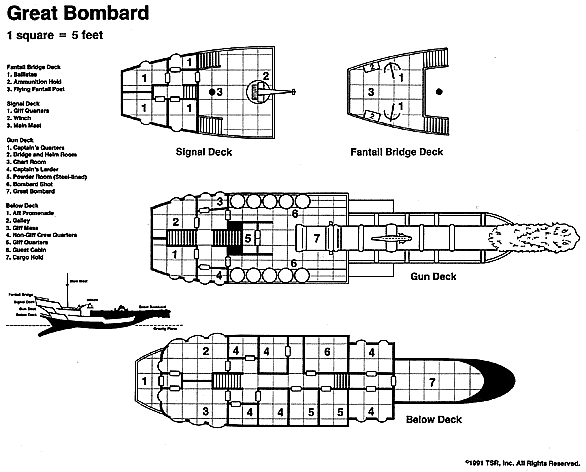
A century later, it was discovered that a promise had also been made between Raxcvillibus and Arachnidion, whereby he would assist them in a future endeavor of their selection. Some argue that these were evidently unfavorable terms, a decision born of desperation, while others posit that it was not Raxcvillibus who consented to them, but rather Grarg, his sentient and malevolent sword, who had momentarily seized control of its wielder.
In 1824, Raxcvillibus upheld his obligation, becoming a signatory to the Drachdekai Pact
In 1729, a treaty was ratified between Ba'lith and the members of the Pact. One of the stipulations mandated that Ba'lith cease sponsoring piracy, a provision the emperor subsequently accepted. Consequently, Ba'lith's economy experienced a robust resurgence. As a result, augmented trade revenue coupled with a prudent and financially adept government, the Klomtroller, has precipitated a marked improvement in the living standards of Ba'lith's populace.
In 1812, the lich Katrana Dumu-loc once more aligns herself with her husband, assuming the role of Empress of Ba'lith. Despite Ba'lith's addition of a throne, many continue to refer to the empire's seat of power as the Throne of Broken Tusks.
The term "Throne of Broken Tusks" emerged during the Horn Tusk Conflict In 1206, a band of minotaurs pilfered elephant tusks from a hallowed elephant graveyard, a site sacred to the Elderaunt people of Ivory Asylum One year later, the stolen tusks from Irastânâz were utilized in the crafting of Ba'lith's new throne, the infamous Throne of Broken Tusks
On the imperialism front, the expansionist tendencies of the minotaurs, driven by their Emperor, continue to threaten the west into Karnegmoth and the lands south of Pipe Home. These colonies are established through the forced relocation of Ba'lith's peoples. Where native populations exist, Ba'lith takes a page from the playbook of Ivory Asylum imperialism, ingratiating themselves as protectors. Then the malevolent nature of Ba'lith comes to the fore, as they tighten their grip on the native peoples, subjugating them.
On multiple occasions, the Ba'lith have precipitated economic stagnation within their nation through excessive piracy. The irony of the situation lies in the fact that they prey upon the merchant fleets of their own countrymen as readily as they do those of others.
Ba'lith boasts a substantial slave population. Periodically, this leads to civil unrest, yet those who demonstrate unwavering loyalty to the empire may earn their freedom.
Architecture
The architecture of the nation is divided between the sharp, ornate, and Gothic features of Ba'lith and the airy domes, wide thoroughfares, and colossal arches of holdings constructed during the Torgilm Confederacy. After converting the populace to diabolical worship, the craftsmen of Raxcvillibus have added fiendish architecture to the state buildings and temples. Some of these structures are replicas of those observed by Raxcvillibus during his sojourns in the Hells. The minotaurs of Azrik are renowned for their architectural accomplishments, including towering walls with sound-producing towers called Moralak. Another marvel of minotaur engineering is a voidship called the Pillar of Horns.