| Category | Races |
| Type | humanoid, large |
| Creation | 11 Bliss 1285 HE |
| Language | Aquan, Langurâpha |
| Native | Bal-Kriav |
When the Hydrocur fled Necrocrypt, they carried off Durkoth tomes and other things from the prison lab Barâb-Tarban. Far to the south, the Hydrocur established holdings on Karë, Tadâph and in the northern bays of Athoreon. Here they used an ancient tome of the Dawn Era named Maurgîn-Hîr, trying and sometimes succeeding in making new lifeforms. Their first success came with humanoids of the nearby mainland. First came a male elephant-like humanoid on 11 Bliss 1285 HE, then several years later, a fertile female, then dozens of more.
The Hydrocur provided their creations with a minimal education. They desired their subjects to be obedient, destined solely for military endeavors. Where they faltered was in teaching their minions the proper use of the Aquan language. Communication enabled the elderaunts to coordinate and ultimately revolt against their overlords. It would take three centuries before they achieved true success. By 1619 HE, they had concluded their cleanup operations, purging Izagunbar of all Hydrocur influence.
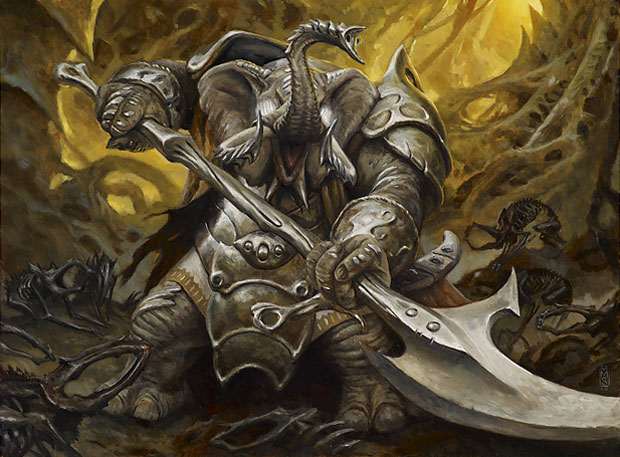
Elderaunts are elephant-headed humanoids standing 7-9 feet tall and weighing 400lbs to 550lbs. Their skin varies in shades of gray, and their eyes are brown or black. They have hairless bodies and are a superstitious people, viewing storms and natural lightning with awe. This is due to the influence of Thjorygg along the northern coasts of Athoreon.
The people of the Athoreon homeland revere ivory as a sacred substance. Through tales, fables, and religious teachings, they learn that ivory harbors a portion of the soul energy of the departed. The Tâchpachâr Empire governs most Elderaunts of Athoreon and enforces stringent laws prohibiting the use of ivory in non-military applications (c.f. Ivory Sanctity ).
Elderaunts progressively develop tusks over time. These natural implements serve as formidable weapons, rivaling the horns of minotaurs. They undergo an arduous trial of survival known as The Hunt for Ivory Storm . Completing this ritual catalyzes rapid tusk growth. The perilous journey deep into the Ma'Ohari region is undertaken by only the most resolute few.
The Elderaunts are a militaristic society. Their motto proclaims, "Better to perish in combat than succumb to wrinkles and illness." Sociologists assert this mentality stems from the Hydrocur, and its eventual decline remains to be seen.
Most elder aunts reside in the region of Izagunbar. Facilitated by Hydrocur technology, they have transformed into a seafaring populace possessing some of the realm's most exceptional maritime vessels. Numerous individuals are citizens of Tâchpachâr.
The elderly view "falling stars" as an ill omen - a period marked by misfortune, inclement weather, turbulent seas, and the wrath of Poseidon.
Ermikel the Balance, excerpt from his book Species - "Elderaunt Omens"
Life Expectancy
The life expectancy of these humanoids is approximately 200 years. A small population of the Elderaunts comprises a group called the Elders. These venerable elderaunts possess lifespans of up to 500 years. Only around 5% of the elderaunt race is bestowed with this "elf-like" longevity.
Customs
Many esteemed elders believe it is their responsibility to civilize underprivileged populations, "the less fortunate." Accordingly, they possess a colonial mindset, governing and safeguarding feebler peoples. Those receiving "assistance" frequently perceive this as exploitation.
The elders of Tâchpachâr are a colonial people. They do not possess a reputation for cruelty or malevolence. The elders profess to exercise equitable governance over less developed civilizations, yet their subjects often hold contrasting perspectives. Some perceive the elders as exploitative of their resources, while others view them as instructors and guardians of their underprivileged populace.
Ermikel the Balance, "The People of the Tusk"
The elder aunts frequently employ words like "fortunate" and "good luck" in their interactions. This exemplifies their superstitious disposition. For the elder aunts, their word carries significant weight, as it represents an honorable bond that should not be broken unless it contradicts the best interests of their tribe. Additionally, it is considered a mark of distinction to offer food and shelter to a companion.
Diet
The Elderaunts are primarily vegetarian. There are reports of rogue and cannibalistic groups south of the Elephant Backbone who believe that consuming their deceased kin facilitates the transference of knowledge from the dead to the living.
Disease - Trunk Rot
Some elder druids unfortunately contend with an incurable ailment termed "Trunk Rot". Regrettably, this malady proves terminal, with no known magical or psionic remedies. It is believed to originate from a flaw inherent to their creation, and attempts to rectify it through even the power of a Wish spell result in a cascading onset of other fatal conditions. Mercifully, the prevalence of this affliction remains limited, estimated at merely 1 in 1,000 individuals within the race.
Family - "Herd"
Families hold paramount significance for the Elderaunts. A male Elderaunt customarily maintains a "herd" comprising 2-4 wives and 4-12 offspring. Amidst the males within the herd, life is inherently competitive, with each striving to attain a robust standing in the family structure.
It is the responsibility of the males to safeguard and furnish sustenance for the family. The duty of the female elder aunts is to nurture the children and oversee the household.
Females have a gestation period of 10 months.
Herbal Medicine
The elderly aunts employ a wide variety of herbs for medicinal purposes. Their community boasts a greater number of shamans than religious clerics.
The Hunt for Ivory Storm
This ritual is undertaken by the elderaunts to expedite the growth of their tusks. The shaman of the elderaunt's tribe must sponsor a quest for the individual. The quest is a challenging and strenuous mission for the creature. Upon successful completion of the quest, the elderaunt's tusks reach full maturity within three months. Ordinarily, full tusk growth is achieved by the age of 100.
Spiritual Rites
The elder aunts often engage in yoga and other pursuits to attain a more elevated state of consciousness and cognition. The employment of the substance known as Wax of Enlightenment significantly amplifies this spirituality.
Beliefs
Elders of the Auran lands are a highly superstitious populace. Some of their long-held beliefs include: - They refuse to travel by sea, as they believe ships will be capsized by malicious water spirits. - Pregnant women are forbidden from attending funerals, lest the unborn child be cursed. - It is considered extremely inauspicious to encounter a black cat, which they associate with misfortune. - Elders will not begin any new endeavor on the thirteenth day of the month, viewing it as an ill-omened date. - Cutting one's hair during a full moon is strictly prohibited, as they believe it will lead to insanity.
- In Ivory Asylum, killing an elephant is a sacrilege to the elderaunts; punishable by decapitation.
- Wearing leather on 50% or more of the body is believed to ward off evil spirits.
- Travel through calm seas and weather is a sign of Poseidon's pleasure with the voyage.
- Elephant graveyards are forbidden grounds; transgression or looting of these areas is a capital offense - punishable by keelhauling.
- Appearances of comets, meteors, and eclipses portend great changes or happening. These changes or happening are not viewed to be benevolent.
- Ivory is sacred to the elderaunts. It is honorable to use ivory only in the decoration of weapons. Jewelry making with ivory or hoarding the material is a serious crime.
Tribal
The elderaunts are a tribal people. Members of an elderaunt tribe regard their clan as a more expansive family. An elderaunt's loyalty lies first with their family, then with their tribe, and finally with the empire.
Battle
The battle serves as a test of prowess and personal honor for the elderaunt, who espouse the saying, "It is preferable to perish in combat rather than succumb to wrinkles and ailments." The race takes immense pride in military bearing and individual achievement. The elderaunts maintain numerous gladiator arenas within the Ivory Asylum. To be a gladiator is considered a great distinction, and the respect accrued from numerous victories ultimately culminates in an elevation of status and influence.