| Category | Empires | ||||||||||
| World | Bal-Kriav | ||||||||||
| Region | Izagunbar, Karnegmoth, Lands of Purity | ||||||||||
| Alias | Tâchpachâr | ||||||||||
| Government | Tusken Council | ||||||||||
| Capital | Orra | ||||||||||
| Population | |||||||||||
| Races |
|
||||||||||
| Alignment | lawful neutral | ||||||||||
| Deities | Poseidon, Atlas, Ptah, Naraz-Nâru, Danzar-Khâl | ||||||||||
| Enemies | Ba'lith, League of Gyalech, Sakullêth | ||||||||||
| Founder | Jurmalon | ||||||||||
| Established | 11 Brightstar 921 | ||||||||||
| Maps |
|
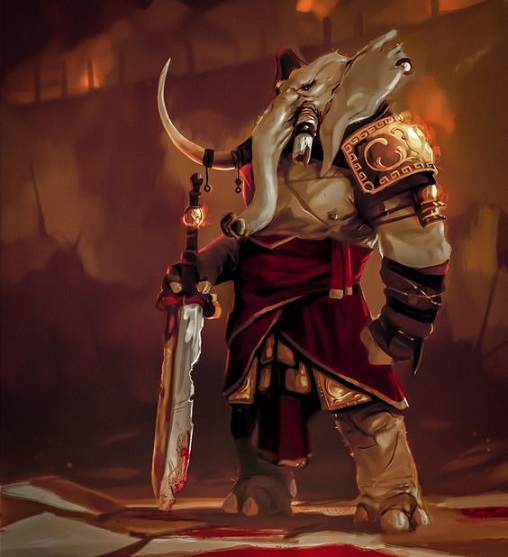
Tâchpachâr, a Langurâpha term, loosely translates to Ivory Asylum. It represented a haven of safety and unity for the Elderaunt tribes who were then embroiled in conflict over the coasts and islands of Athoreon. The driving force behind this unification was the hero Jurmalon. He sought to end the tribal infighting that had persisted since 1619 HE, the year in which the Elderaunt's former masters and creators were expelled from the region. With the Hydrocur gone, the victors turned to tribal allegiance.
In the last century of the First Epoch, the Salzârrâk, a channel sea separating two continents, emerged as a major trade route to the island ports of Iron Bottom. To help quell internal unrest, the government of Ba'lith openly sponsored piracy and mercenary ventures, sowing the seeds of the Horn Tusk Conflict (1023 - 1467).
The Minotaur Inlet became a hunting ground for pirates that greatly outnumbered Ba'lith's small navy. State-sponsored piracy posed a serious threat to the Elderaunt city-state of Rîni, located on the western side of the strait and part of the Iron Bottom Oversight Board, which was charged with policing the area's commerce. Greatly affected by Ba'lith's mischief and unable to cope with their neighbor's growing naval presence alone, the unification of Athoreon's Elderaunt city-states was necessitated. In 11 Brightstar 921, Ba'lith's aggression gave rise to the Elderaunt empire of Ivory Asylum, led by the figure of Jurmalon. Though the people were still largely tribal, it became a confederacy of city-states and tribes that would eventually evolve into a federalist system. Tribal thinking remained an issue, with four great tribes holding more political influence than the many smaller ones.
Situated behind deep bays, the Ivory Asylum boasts an extensive history of naval tradition and combat expertise. Their island fortresses and coastal defenses, bristling with Cyclops Cannons, cement their status as one of the preeminent maritime empires of the realm. Their sailors, trained from a young age on ships for nearly four years as mandated by law, have become masters of the seas and are renowned as some of the finest navigators of the Ten Seas.
Admiral Gima-Kilc, of the Knights Fleet, excerpt from his book - "Naval Might - The Ivory Asylum"
The Ivory Asylum perceives itself as the savior of the Tragarans who came to inhabit the Hells Womb and the Lands of Purity. This is because during the Gulimbor Cataclysm, the Tragarans were frequently pursued by the naval forces of the First Khazarkar Empire. In the Battle of Satheon, the elderaunts engaged the Khazarkars in combat and crippled their navy. This victory enabled the refugees from Gulimbor to sail northward, escaping their pursuers and the catastrophe unfolding in Gulimbor.
In the ensuing centuries, Ivory Asylum's assistance has not always been well-received. The Elderaunt's "superior civilization complex" often strained diplomatic ties. The Elderaunt's aid has manifested in various ways, including "coastal patrols," deploying expeditionary forces, punitive naval operations, and the not-so-welcomed practice of colonialism.
Ivory Asylum and Ba'lith have endured numerous confrontations. From state-sponsored piracy of Ba'lith to a period of Ivory Imperialism ( 971 ) where through cultural dominance and enlightenment, one attempted to subdue the beast within the other. The pinnacle of these hostilities, an intermittent war, came to be known as the Horn Tusk Conflict.
In 983, as a signatory to the Treaty of Mazâd-Khâl, Ivory Asylum relinquished its claims over Mazâd-Khâl and Tigošal.
The Ivory Asylum projects its maritime influence by establishing ports in distant regions. In the year 1020, they constructed settlements along the western coasts of Ma'Ohari, founding the port city of Ivory Ward. This location, as well as Salandirik, would for many generations serve as significant harbors and defensive bulwarks against Ba'lith hostility and the burgeoning pirate menace emanating from the Buccaneer Archipelago.
In the year 1244, the Giff League traversed the Void. Upon arriving in the region of Izagunbar, they swiftly established diplomatic connections with the Ivory Asylum. The two empires then commenced a flourishing trade relationship and forged a military alliance that has endured unbroken. Indeed, their bond is so steadfast that citizens of Elderaunt and the Giff League now possess dual citizenship.
In 1509, Ivory Asylum established the Târuk Hidar colony on Vhurghad.
In 1693, Ivory Asylum joined the Pact of Behemoths. Thirty-six years later, after the Azrik Blockade ( 1693 - 1729 ) , this development would have the consequence of terminating Ba'lith's longstanding tradition of sponsoring and harboring pirates.
In the year 1712, the Sargolmon Federation compelled the Ivory Asylum to relinquish their colonies on Vhurghad.
The empire possesses numerous island cities on the Pearl Sea, as well as colonies across various continents, in addition to their native territories in northern Straiden. Many view them as imperialistic, gradually securing outposts before seizing control of the surrounding regions.
States of the Confederation
The Ivory Asylum is composed of numerous elderaunt tribes. Each tribe serves the needs of its people as well as the collective interests of all elderaunts residing within the Ivory Asylum. Collectively, these tribes form the confederacy known as the Ivory Asylum. The Ivory Asylum encompasses four principal tribal states, each representing a distinct geographical region.
| Tribe/State Name | State Capital | Region | ||
|---|---|---|---|---|
| Abusai | Rîni | Izagunbar | ||
| Duraigosân | Orra | Izagunbar | ||
| Ethâr | Lamprophyre | Izagunbar | ||
| Rachat | Vraga Moltus |
|
Architecture
The settlements of the elderaunts reflect the longstanding naval heritage of the empire. Structures are occasionally constructed in a triangular fashion, evoking the appearance of a grand sail. The street layouts mirror the intricate pattern of a ship's wheel, with a central marketplace at the core and the radiating thoroughfares serving as the spokes. Furthermore, numerous towers of the empire feature crow's nest-inspired spinnerets, which are meticulously shaped and adorned.
The Ethâr's architectural design centers around the captured structures of the Rilirthad. The stonemasons and engineers recognized that extensively altering the cities to match their typical styles would be prohibitively expensive. Instead, they worked the stone to complement the architecture of the former builders of Karnegmoth, the northwestern region of Straiden. The Ethâr cities stand as impressive sights, towering high above the surrounding swamps and jungles. They rest upon a foundation of crushed stone and sand, hills constructed through the laborious efforts of the Rilirthad's elemental sandmen and miner genies.
Related Information
Holdings
- Kol'taa
- Lamprophyre
- Nanarôzê (c.f. Mânelurûs )
- Orra
- Rîni
- Selûn
- Skarn
- Ulpa
- Tulurôzê (c.f. Mânelurûs )
- Vraga Moltus