| Category | Wars | |||||||
| Period | 1697 - 1723 | |||||||
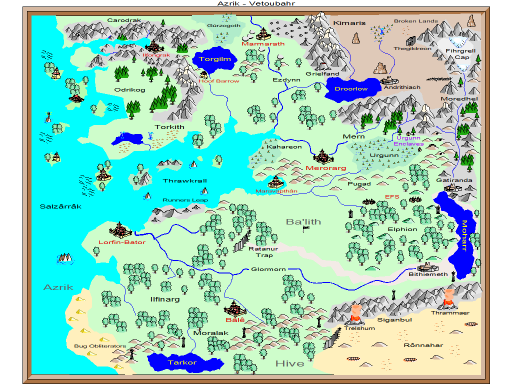
| Theater | Azrik, Maleddanar, Ma'Ohari | |||||||
| Belligerents |
|
|||||||
| Maps |
|
When the Coeus Civil War ( 1694 - 1697 ) concluded, Ba'lith's armed forces demolished the churches of the now deceased deity Coeus. In their stead arose grandiose edifices dedicated to the nation's new diabolical religion, the Church of Asmodeus.
With veterans of two consecutive wars, Ba'lith 's emperor directed his armies northward. He was executing the next stage of a strategy devised by Asmodeus. The sword and cunning to implement this phase belonged to Emperor Raxcvillibus, a foreigner, a fabled general of the empire, a hell knight educated in diabolical methods, and with a near-fanatical military loyalty to him.
Meshin, a Ba'lith intelligence operative, commenced collecting information and seeking allies during the final two years of the Coeus Civil War. One operation uncovered a point of contention between Ilfongrak and the Underdark empire Taklumlode, which centered on the lucrative iron deposits of Zirâg-Tharam. Rax and his general staff leveraged this knowledge to devise a strategy for securing an ally.
In the year 1697, the ongoing strife between the minotaurs of the northern and southern regions, as well as their respective allies, became known as the Brothers Enmity War.
The aspiration of Raxcvillibus, the sovereign of Ba'lith, was analogous to those of his predecessors who had previously occupied the Broken Horn Throne - the unification of Azrik. The Torgilm Confederacy ( 1475 - 1719 ) , comprising the minotaurs and other northern Azrik denizens, harbored no desire to be assimilated into the southern state's warmongering ways.
The Minotaur Trade Federation, the custodians of the purse, were ardently desirous of another conflict. They recognized that a protracted war would cripple the empire's finances, yet if they could secure alliances, they would emerge triumphant. The MTF gambled on supporting the third in a succession of wars, with the objective of gaining access to the north's distinctive Carodrak Glass and the vast iron deposits of Zirâg-Tharam.
Two years into the conflict, feeling the strain of the Azrik Blockade ( 1693 - 1729 ) , Ba'lith sought an ally to share the financial burden. Taklumlode joined the war on Ba'lith's side, underwriting a conflict that could potentially grant them a city and a greater share of Zirâg-Tharam.
Fall of Ilfongrak
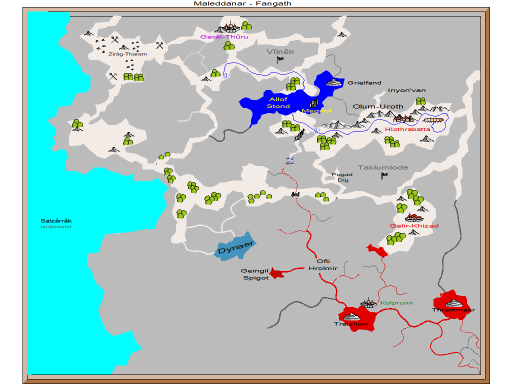
The battles of this war occurred on the surface and beneath. On the surface, Ilfongrak 's mountain defenses provided early warnings of the belligerent's movements. They assumed a defensive posture in defiles and across a very rugged landscape. While they engaged the armies of Ba'lith in the Carodraks, their enemy's ally Taklumlode assaulted the labyrinthine defenses beneath Ilfongrak with hammer golems, herds of gorgons, and other perilous creatures. On the surface, a Maug mercenary army led the attack against the city's walls. These heavily armored beings, with their capacity to "pulverize" objects, were instrumental in capturing the city. They suffered substantial losses in these engagements, bearing the brunt of the defenders' artillery and magic. General Shali-Vor, a death knight of the Lix Tetrax, derided the destruction, his words insulting to his own minotaurs, "Heed the dying cries of your foes, they sound like a herd of cattle being led to the slaughter." The southern soldiers' objective in the war was unification, not depopulation. When word of this reached their emperor, the leader of the Lix Tetrax, Shali-Vor was never heard from again. It is said he was removed from service and placed in a temporal stasis tank until the situation stabilized.
In 1719, Ilfongrak, the heart of the Torgilm Confederacy ( 1475 - 1719 ) , was captured by the armies of Ba'lith. Following its fall, the surrounding highlands erupted into a protracted guerrilla conflict that endured for an additional two decades.
Capture of Hlothrabatta
After assisting Ba'lith in securing key locations around Ilfongrak, Taklumlode invoked the mutual defense pact obligations of Raxcvillibus. Bound by law, Rax dispatched the Starless Army into the depths. They united with the allied forces of King Taklumlode XII, ruler of Taklumlode. Analogous to the surface conflict, brutal battles proliferated in the darkness, with the city-state of Hlothrabatta as the focal point. In the final month of 1723, Hlothrabatta became a holding of the Taklumlode Empire. The Brothers Enmity War had reached its conclusion.
During this conflict, a number of Gimrune engineers and scientists of the Torgilm Confederacy fled the region. Yet surprisingly, nearly an equal number stayed put, becoming citizens of the Ba'lith Empire. They were rewarded greatly for their help in the years to come. Ba'lith had long desired crafters with a deep understanding of how to make and maintain sonic weaponry, what the Auhtai called Päiki-Synhö. They also acquired engineers and workers experienced in the building of skyships.
Assisting the forces of Ba'lith were thousands of mercenaries from the Bloodtusk Regime. Under a pact with Raxcvillibus, the kingdom's undead overlord, Admiral Bloodtusk, old comrades from the early years of the Black Tide, agreed to make no territorial claims, but was free to claim all the spoils his mercenaries could seize. It is recorded that these Skull Brigadiers were responsible for some of the conflict's most heinous atrocities - with Maleraunts known to have a penchant for expelling prisoners from the mouths of cannons or hurling them into canyons via catapults.
Related Information
Notable Battles
- Siege of Ilfongrak