| Category | Wars | |||
| Period | 10 - 25 | |||
| Theater | Turgon | |||
| Belligerents |
|
|||
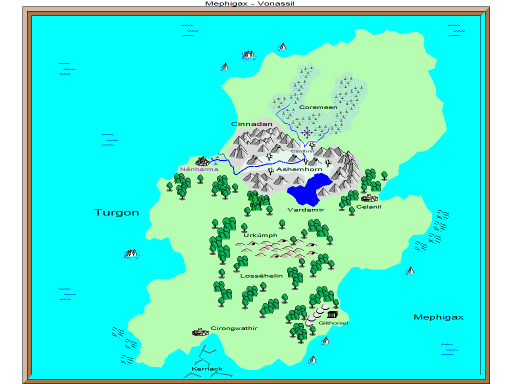
| Map | Turgon |
In the Dawn Era, the northern half of Turgon became the stomping grounds for the lizard-like humanoids known as the Graagvrii. Next, a group of ex-Covenant soldiers who had fought in the Demon Spawn War settled in the heavily wooded interior of the island's south, establishing a permanent home in the region called Lossëhelin. The Kriavfahliil were the subsequent inhabitants, arriving in the Horgon Era as Gwildath colonists from the world Kriav. Their arrival would ultimately lead to a conflict that forever transformed Turgon, turning it into a demon bastion and a foothold on a mortal world ruled by a demon lord.
The coastal-dwelling Kriavfahliil typically regarded the island's Graagvrii as primitive and savage. They disapproved of the lizardfolk's belief that might makes right, an ideal deeply rooted in their veneration of Semuanya. In contrast, Turgon's wood elves viewed the lizardfolk as more equal counterparts, having endured sufficient conflicts with them to recognize the value of avoiding reasons for their neighbors to unite.
In the ninth year of the First Epoch, the four great tribes of upper Turgon were compelled to unite. The policies of Nénharma, a Kriavfahliil city-state, had proven remarkably effective at diminishing the populations south of the Cinnadan mountains. These southern-dwelling lizardfolk, referred to by the elves as the "free lizardfolk," existed outside the four primary tribes of northern Turgon. They served as a means of maintaining a presence in the wetlands and rivers of the south while remaining "officially unaffiliated with the four tribes of Coremeen."
The Graagvrii and Vedrii joined forces under the Tetramord Pact. The magnitude of the menace was such that the wood elves of Lossëhelin and their coastal dwelling neighbors, the Kriavfahliil, were compelled to unite under the Phael alliance.
For the initial three years of the conflict, they engaged in battle within the Ashemhorn valley. The Phael, commanding the Turgon Aeries, positioned themselves behind robust fortifications. These were focused around ancient mountain strongholds that during times of tranquility functioned as monasteries for religious devotees.
Making no headway down the valley, the Tetramord moved eastward, attacking the coastal city of Celanil. Along the way, they were relentlessly harried by wood elves concealed in the treetops, who sniped and assassinated with devastating effect. In the Year 13, Celanil finally succumbed to the Tetramord. Their forces had suffered greatly in the process, including three grueling years battling the entrenched defenders of the Turgon Aeries. As a result, the Tetramord's commanders struggled to contain their soldiers' thirst for vengeance. In the end, they reduced the city to ruin, slaughtering all those they had captured.
After Celanil was sacked, Tetramord armies marched west through Lossëhelin, the homeland of the island's wood elves. It necessitated two years to carve a path through, necessitating the establishment of formidable garrisons and fortifications in their wake. Assaults on their supply lines remained a persistent challenge. The battles with the wood elves often involved deception, subterfuge, and guerrilla tactics. Tetramord, a blend of Graagvrii and Vedrii, were adept at such maneuvers, yet they paled in comparison to the expertise of Lossëhelin's wood elves, the progenitors of the Angrods.
In the Year 16, the city-state of Nénharma was the next to confront the Tetramord onslaught. General Shearmor, a ruthless Vedrii, approached within speaking distance of the city. To his chagrin, he nearly lost control of his mount; a malevolent rage drake named Bilsick. The general wondered if the unruliness of Bilsick was the work of elven trickery, never considering that his evil sentient steed simply craved elven flesh and had no interest in a parley. After six months of siege operations, Shearmor offered the besieged Nénharma safe passage. He warned of the consequences if they continued to resist, glancing back towards Celanil. Cut off from reinforcements and facing a force of nearly 20,000, Nénharma accepted the offer. However, when outside the city and en route to the elven stronghold Finwë, General Shearmor ordered an attack on the refugees. Thousands of civilians and soldiers were massacred. In the wake of this treachery, Phael would begin employing similar tactics against their enemies.
The war continued to rage on after his death, with immense casualties sustained by both sides. Mercy was seldom shown. The tide of the war shifted in favor of the Phael in the Year 21. As the Tetramord front was pushed back, the Phaels passed through the ruins of their former strongholds and cities. The sight of the ruins and the bones of their fallen comrades filled the elves with profound grief. This grief soon turned to anger and a thirst for revenge when they learned of the true horror that had befallen the deceased. The bones were scattered and broken, as if ravaged by wild animals, and divination spells revealed that many of their kin had been consumed while still alive. The Phael declared that no mercy would be shown to the Tetramord, and that the civilizations of the lizardfolk must be eradicated. As the elves neared the wetlands of Coremeen, they encountered fierce resistance. The Phael wizards and priests conjured minions to assist them, but some of these creatures refused to work with their summoners, claiming that their methods were evil. The conjurers then turned to those with fewer moral qualms, reasoning that pitting evil against evil was as valid a choice as any, as long as one side perished.
In the Year 23, a rift was opened in the Web of Magic. Seeking the assistance of a dozen or so vrock demons, the spell ruptured the fabric of the Web, forming an inter-system rift. This rift was initially small, but soon expanded under a Zone of Great Magic. This then escalated into a Cascade, with disastrous consequences. The rift, which became known as the Ungorth Reddik Road, grew to nearly a hundred feet in diameter. It led to one of the worst realms of the Abyss, the walls of Ungorth Reddik. This sinister place on the world Abyssm is a major citadel of the demon lord Demogorgon. Demogorgon's legions poured through the gate, wreaking havoc across Turgon. The Phaels were forced to retreat hastily. The demons grew in number and began to overwhelm the defenders of Turgon.
At Solendë, we fought shoulder to shoulder with our former adversaries. The animosity we had once harbored faded into oblivion as we united as an elven and lizardfolk army, facing the onslaught of enemy forces together.
Helendë, of Spirachiln - "A Common Foe"
The island's wood elves and Kriavfahliil headed for the coasts, taking ships and using magic to swiftly escape the lands falling prey to the demons. This exodus, known as the Turgon Exodus, which spanned from Year 13 to Year 25, led many to journey northward across the Mephigax and settle in the High Wood Country. Meanwhile, the Celanil sailed south, re-establishing themselves in the Weretopia region, while the Tetramord suffered a dreadful fate under the demons' onslaught.