| Category | Cities | ||||||||||||
| Continent | Brucrumus | ||||||||||||
| Region | Aerie of Dragons | ||||||||||||
| Alias | Okaaz Spiir, Heel of Hiznaar Goz | ||||||||||||
| Owner | Oathundor | ||||||||||||
| Population | |||||||||||||
| Races |
|
||||||||||||
| Founded | 29 Lunar 980 HE | ||||||||||||
| Map | Hiznaar Goz |
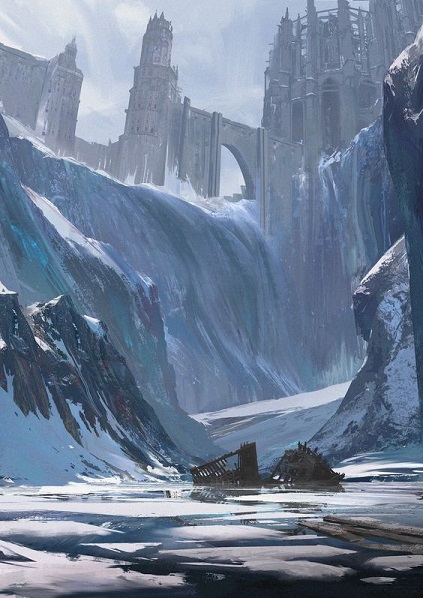
Okaaz Spiir, Draconic for Sea Spray, is situated atop the towering cliffs of Hokzii Rotmindol. In 980 HE, the Zeymah'kein constructed this coastal watchtower, which overlooked the bay of Nahkropiik Vaal to the south and monitored for giant activity in the hills of Gorahrigir.
Nestled on the edge of a fjord, the builders of this settlement never envisioned it blossoming into a prominent seaport. Lacking a strong naval presence, Zeymah'kein constructed Okaaz Spiir primarily as a means of deterring raids along the nearby fjords. However, an unforeseen twist in the settlement's history, facilitated by agents of Primus, transformed it into a trading hub for plundered goods. Merchants could purchase these spoils from the raiders, then resell them at inflated prices in Zeymah'kein's northern cities, reaping substantial profits in the process.
In Zeymah'kein's final months, Okaaz Spiir fell to Gorahrigir's hill giants. The giants' claim over the city was contested by the Mir'piamauza Empire, the victor of the Last Burn (1577 HE - 1600 HE). They asserted that all of Akhosia's former lands, holdings, and peoples had become the rightful property of the conquerors by the rule of war. Rather than engage in all-out war against a place that had resisted numerous attacks, "the Heel of Hiznaar Goz," they opted for a strategy of destabilization, sowing dissension among peoples long known for their tribal allegiances.
Mir'piamauza's ambition of incorporating this city into their empire did not come to fruition. The Mir'piamauza Civil War (1608 HE - 1612 HE) resulted in Irthorn and numerous other Mir'piamauza and Zeymah'kein strongholds attaining independence.
By 1700 HE, Irthorn had deteriorated from its former grandeur. Many of its structures lay in ruins, with wild animals and raiders freely roaming through streets obstructed by debris and overgrowth. Over the ensuing two centuries, it remained a dilapidated settlement, serving as a haven for various giant-hunting expeditions, brigands, and other unsavory entities.
Around the Year 100, hill giants commenced the process of rebuilding. They secured the area, effectively driving off the bandits and monsters that once roamed freely. With the restoration of security, the old markets were promptly reopened, attracting people to reoccupy the long-abandoned buildings. Kriistvrii, many of whom possessed lineages tracing back to the families that once resided here, returned, introducing their laws and customs, which, more than any other factor, established law and order, thereby spurring the growth of civilization and the rise of Irthorn as a prominent market and anchorage.
By the year 900, Irthorn had blossomed into a powerful city-state with three grand harbors - one situated south of the city facing the bay, and two to the north overlooking the fjords. These harbors emerged as a result of the escalating commercial rivalry between Irthorn and their kinsmen at Thithak. The two cities competed ferociously for trade with Sourm-Gar and other Tragaran strongholds along the southern shores of the Sea of Mourning. There is much debate over which city boasts the superior harbors, a dispute that has led to countless brawls in the rowdy mead halls. The prevailing view is that Irthorn's harbors are better protected, requiring the expertise of skilled pilots to navigate the fjords, while Thithank's are more easily accessible and offer cheaper docking fees.
The harbors of Irthorn serve as homeports for numerous colossal vessels. The most renowned are the Grimsuvelth Trawlers. Traversing the fjords to reach the smaller communities is frequently accomplished via grand ferries. Those abandoned due to wear and tear often become domiciles or are converted into encampments for the city's indigent population. These riverine dwellings extend for several miles along the fjord, and at least a dozen are lost annually to cooking fires.
In the year 1472, Irthorn was designated as the capital of the newly established Kingdom of Oathundor.
The giants of Irthorn, those of Oathundor, are not the type that descend from the mountains to steal your grain and livestock, or pillage your villages and towns. No, they are just as refined as we goblins who have embraced Irthorn's mercantile fervor. There is something about this place that ensnares you in the pursuit of deals. One of the market's sages, an aged, grizzled half-devil, claims this is the work of Primus. He pointed to the merchant stalls and their astute dealers and buyers, all of whom adhere to the creed: "Stay busy, trade fairly and often, think of your next venture, and keep your mind clear of Chaos's tendrils."
Snakeye, from his book A Goblin in Irthorn - "Always Trading"
Notable Areas
- Dragon's Anchor (forge)
- Kamoni High Road
| Zeymah'kein | ||
| Irthorn | ||
| Thithak | ||
| Oathundor |