| Category | Wars | |||||||
| Period | 1190 - 1240 | |||||||
| Theater | Northern Hordelands | |||||||
| Belligerents |
|
|||||||
| Maps |
|
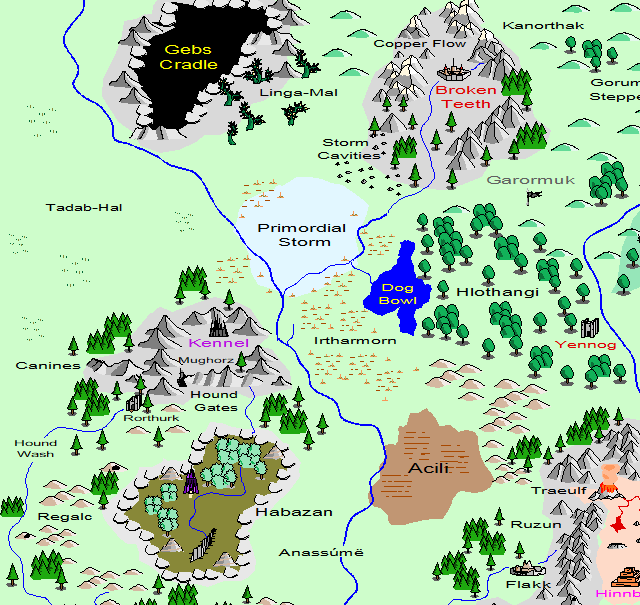
The Witch-Pack War, spanning five decades, was a period of hostilities between the two dominant antagonists of the Northern Hordelands. In the west, centered around the ancient city of Incubus, were the Theegans of the Witch Horde. From the east, a federation of Gnoll tribes gathered around the five-hundred-year-old walls of Broken Teeth. The events leading up to the war had repeated numerous times. Those inhabiting and hunting near the plains of Tadab-Hal held contrasting views on the region's vast herds. The Theegans, renowned horse breeders and trainers, greatly valued the wild horses. Conversely, the gnolls, with their bestial nature, regarded everything wild as prey, even resorting to consuming their own kind. They taunted the Theegans over their horse hunting. In 1190, the Theegans deemed it time to prune an enemy that had repeatedly failed to become civilized, regressing instead to their demonic, bestial ways.
If not for the appearance of the Jara Horde, the two sides might have been able to settle the affair with a few skirmishes and a few hundred dead, sating their honor. The ferocious centaur horde that descended from the north was the Rampager Horde. Ally to neither, friend to none, this Jara horde numbered fifteen-thousand. Overwhelmed by the initial onslaught, the nomadic Theegan of Tadab-Hal fled south, and some east. Those who traveled east found themselves in the lands of the Garormuk Federation. Thinking these to be the vanguard of an invasion, the gnolls rallied their tribes. While they skirmished, each side was quick to take advantage of the chaos sown by the Jara horde rampaging across the Northern Hordelands.
Jara Rite of Strength
In 1192, the Witch Commander Zenarân requested a Rite of Strength from the Jara's leader. Typically performed to select a new Jara leader, Chieftain Rampager, a renowned Jara Khan, met his match on the grassy plains of Tadab-Hal. The agreement was that if Zenarân emerged victorious, the Jara would turn eastward, abandoning their rampage. The Theegans prepared for the Jara's customary breach of truce, deploying in defensive squares of pikes, supported by javelin throwers, heavy infantry, and archers. However, the expected attack never materialized. Stunned by the swift defeat of their khan at the hands of one wielding both Blizzard and Firestorm, the Rampager Horde scattered, retreating to their windswept northern steppes.
With the Jara predicament resolved, Zenarân led her cavalry legions eastward, forcing the gnolls to retreat across the river Anassúmë where they fortified their defenses against a multitude of pontoon bridges and a fleet of barges and riverine transport. Others withdrew southward into the Canines, and to the ancient demon strongholds of Kennel.
The False Drungods
In 1195, the gnoll federation found itself on the defensive, taking refuge in caves, the depths below, or their fortified mountain valley strongholds. On 9 War March, the morale of the Garormuk Federation was bolstered by the resurfacing of a figure from legendary lineage, a Drugnod. This gnoll chieftain, after drinking from the Pool of a Thousand Dead, provided proof of his Drugnod heritage. Named Khro'gaz Drugnod, he hosted the spirit of a soul lost centuries ago, a pawn of the Widows of Modrerthim and their demon prince. Khro'gaz achieved many victories, but at the second sacking of Briltarn, he was felled by an upstart guild of assassins working for the Witch Horde. The efforts of these Sanguine Whispers assassins continued throughout the war, three times killing a "false" Drugnod. When the last such imposter fell in 1230, the Witch Horde launched a renewed offensive.
The city of Kugirmuk, a member of the Garormuk Federation, succumbed to the Witch Horde in the year 1235.
In the year 1240, the exhausted combatants ratified the Witch-Pack Peace Accord.
Notable Battles
- Siege of Kugirmuk