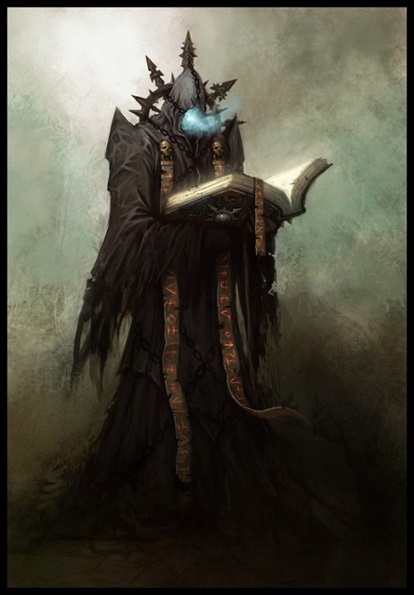
| Category | Governments |
| Type | Syndicate |
| State | Paradomea |
| Leaders | The Syndics |
| Formed | 1 Hollow 1290 |
In 1290, the heads of the largest and most powerful merchant houses in Paradomea, a governing body known as the Merchant League, reorganized under a renewed business charter. They established another entity called the Council of Nine. As a prerequisite for becoming a leader in this organization, each individual had to relinquish their mortality, a sacrifice meant to demonstrate their worthiness. Over the course of the remainder of 1290, each member embraced lichdom, swearing oaths to pursue endeavors that would benefit the economic interests of Paradomea. Since then, becoming a Syndic and joining the Council has required the transformation into a Lich.
Even as liches, with their inclination toward malevolence, these Syndics have achieved remarkable success for Paradomea City and the empire's other territories. For centuries, they have sustained unity with only occasional intervals of internal discord. Some attribute the Syndics' ideals of robust law and order to the presence of the Ebon Bedrock beneath the Palace of Nine.
In the year 1292, the Council of Nine established an agency known as the Paradomea Consortium. This commercial organization was created to assume many of the routine obligations previously undertaken by the Merchant League.
When the Council of Nine is not occupied with governing an empire, they engage in the creation of magic and the performance of magical experiments. In the year 1312, several Syndics employed components of the Ebon Bedrock in the fabrication of the Prisms of Worlds.
The charter of the Council of Nine mandates that the Council consistently maintain a membership of nine individuals, all hailing from a prominent merchant house, with the financial prosperity of Paradomea consistently taking precedence over private interests, and that each member must be a lich.
The Council's syndics generally maintain a neutral alignment, their primary focus being the growth and prosperity of Paradomea City, Aggis, and their other holdings. They have allied with numerous empires, both virtuous and wicked, fighting in many wars, yet they have never sought outright territorial expansion. They typically achieve the latter by negotiating deals, often with the opposing party at a strategic disadvantage (see Aggis ). This is not to say that some of the Syndics lack a certain malevolence. As undead beings, they can never fully escape their inherent wickedness, though they may attempt to suppress it. If a Syndic proves to be excessively evil or self-serving, they are permanently removed from their position.
In the Black Tide War ( 1465 - 1486 ) , Paradomea maintained a posture of neutrality amid the surrounding conflict. They discreetly supported certain groups, such as the Gray Matrix, but not to an extent that would jeopardize their 1466 neutrality agreement with the Dead Council.
The Council of Nine is headquartered in an obsidian citadel known as the Palace of Nine.
The complete vanquishing of an adversary and the imposition of dominance over their people can frequently engender more detriment than benefit. Widespread civil discord and acts of sabotage will customarily transpire, and the populace is less inclined to participate in the advancement of your economy. Alternatively, permit the vanquished to preserve certain of their establishments and render tribute to your administration.
The Arbiter, from his renowned work Making War Profitable, outlined the "Maxim of War" as follows: War is a profitable endeavor for those who wage it wisely. The key is to prolong the conflict, ensuring that neither side achieves a decisive victory. By perpetuating hostilities, one can extract wealth from both combatants through the sale of arms, the provision of logistical support, and the management of reconstruction efforts. Prolonged wars also weaken the social fabric of nations, rendering them more pliable to external influence and manipulation. In this manner, the true victor emerges not from the battlefield, but from the counting house. The spoils of war are harvested not by soldiers, but by the cunning financiers who arm them, feed them, and rebuild what they destroy.
The Tearberon is a covert guild sponsored by the Council of Nine.
The Syndics
The governorship of Paradomea is overseen by nine syndics. Their decisions are not made alone, they follow the empire's Merchant Code where business interests are of highest concern.| Syndics | Position | Joined | Other |
|---|---|---|---|
| Belecthorn of the Woods | Syndic of Resources | ||
| Caraldrarg the Firebender | Syndic of the Arcane | ||
| Lorkiee | Syndic of Defense | 1554 | |
| Hidrist the Unforgiving | Syndic of Internal Affairs | Police Chief of the Gilogoth Magistrate | |
| Lasestrov | Syndic of Special Projects | 1453 | |
| Sarurkane | Syndic of Commerce | 1290 | Westerlies Agreement, Nullattîm Balance |
| The Arbiter | Syndic of Economic Defense | ||
| Tome | Syndic of Records and Legislation | 1290 | |
| Umgitharg the Psi Stealer | Syndic of the People |
| Syndics | Position | Joined | Separation | Other |
|---|---|---|---|---|
| Bind Izudîm | Syndic of Defense | 1290 | 1554 | 1468 Black Tide Report |
| Cryanus | Syndic of Commerce | 1456 | 1466 | |
| Lainómë | Syndic of Special Projects | 1456 | 1453 | found giving excessive preferential treatment to her home city of Belogrell, killed by Sarurkane Branda |
| Kloidan | Syndic of the Arcane | 1552 | killed by a weave spider in the Artery War | |
| Nargontou | Syndic of Internal Affairs | 1295 | 1392 | killed by thieves under the Palace of Nine |
| Razzir | Syndic of the People | wanted for treason |