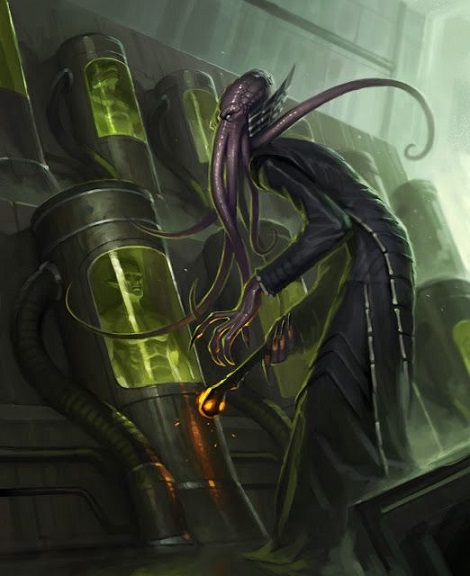
| Category | Races |
| Type | humanoid, aberration |
| Creation | 14 Temporal 1987 DE |
| Language | telepathy - can communicate with any intelligent mind |
| Native | Bal-Kriav, Ráglauth, Urkolon |
In the Creation War ( 1486 DE - 8777 DE ) , the primordial lords, and any of their minions who could obtain one, employed entropic ponds to create their minions. These minions became servants, soldiers, administrators, or any role envisioned by their creator. For the most part, these primordial lords prioritized quantity over quality - a characteristic seemingly inherited by the demons.
Among the primordial lords, greater status was conferred upon those with more minions. However, this very trait became their downfall and that of their progeny. The demons, spawned from the primordials, also rely on numerical superiority to overwhelm their adversaries. In contrast, the true masters of warfare, the devils, prefer to employ strategy and tactics to compensate for their comparative numerical deficiency. I have personally observed countless instances where devils of equal or even lesser strength than their demonic counterparts emerge victorious through the application of skillful stratagem. This is no innate ability, but rather a hard-earned expertise, meticulously documented and studied over the course of millennia spent facing hordes of demons that almost invariably outnumber them.
Rax, excerpt from the Generals of Hell - "Demon Mob Tactics"
The first illithids originated from an accident at one of the Entropic Ponds of the Nine-Tongued Worm. This incident occurred when a Lith-Crillion slave fell into one of these vats of liquid entropy. In most cases, this resulted in the destruction of the creature as their soul energy and essence were converted back into raw energy. However, this did not happen with this particular individual. It is theorized that the neothelid being created in the pool at the time fused with the psyche of the hapless slave. This produced a tadpole-like creature that gradually morphed into a humanoid with a head of flailing suckers, rather than a primordial aberration. This new creation was dubbed an illithid. The Nine-Tongued Worm decided that the psychic potential of this being warranted mass reproduction. Initially, this was done carelessly, leading a population of several hundred illithids to decimate their master's slave population with their brain-feeding abilities. Subsequent batches were more selectively bred and assigned roles befitting their elevated intellect.
Illithids were perilous to their adversaries and sometimes a menace to their primordial overlords. Exceedingly cunning and highly intelligent, illithids are lawfully inclined, a consequence of their Lith-Crillion lineage. Their sustenance requirements, consuming sentient brains, can strain an army or settlement. Consequently, illithid colonies were culled by their primordial masters whenever they became too firmly entrenched in an area, too populous, or in some way proved to be a potential threat to their overlords. After a time, word spread about these cullings, and fearing that he would one day be part of one, an illithid named Ilsensine devised a means of continuity.
Illithids do not speak of passing away, but rather of Commencement An illithid does not confront oblivion or some spiritual unity with its deity after demise Instead, it undergoes a union with the elder brain, a state of being where its mind and faculties will endure for all eternity - or so each illithid firmly believes [ 1 ]
The elder brain for Ilsensine's colony was the first of its kind. It required the psychic energy of 73 illithids to be brought into existence. Many volunteered and made the sacrifice, forfeiting their physical forms to decay while their mental capacities were channeled into the growing cerebral mass, granting it greater sentience with each fusion. The final twenty or so individuals, however, needed to be *persuaded* to merge with the entity.
The colony of Ilsensine was fortunate, as they never incurred the wrath of the Nine-Tongued Worm. When this primordial entity was vanquished by the commanders of the Nawirrûs Covenant, the illithids were nearly eradicated by the angels and their divine masters. Ilsensine escaped with several dozen others and their elder brain. For the remainder of the Creation War, they remained well-hidden from both the primordials and the gods. During this time, Ilsensine devised a method to have an elder brain sever a portion of itself, which could then be utilized to cultivate another elder brain and serve as the focal point of a new illithid colony. The legend of Ilsensine is known to all elder brains, and it is the reason why he is revered as the patron deity by most illithids.
The illithid remained concealed during the God Era, building up their civilization on Ráglauth, and eliminating those of others around them. They came to dominate their world (which is merely a moon of Ghífthauk ). In the Lith-Crillion Era, they began stealthily spreading to other worlds. These were groups that became autonomous immediately upon arrival. After several generations, even the elder brains had largely forgotten their Ráglauth heritage. Some believe these colonization efforts were carried out as part of Ilsensine's Grand Plan to first infiltrate and then unify all illithids under one great power in Nawirrûs. The masterminds of Suellk believe they are the chosen power to accomplish this.
Illithid developed light sensitivity from their origins in the post-Dawn Era on the cloudy, rain-soaked mini-world of Ráglauth. This celestial body receives far less illumination than worlds like Bal-Kriav and Ghífthauk.
One of the most formidable illithid populations is the Suellk. Their considerable size, unrelenting aggression, and insatiable need for nourishment have decimated the populations of numerous moons and worlds.
| Trait | Description |
|---|---|
| Infused Law | Illithids are almost always lawfully aligned; a trait of their Lith-Crillion heritage |
| Racial | as illithid |
| Lifespan | 125 years |
| Height | 4'7″ - 6'1" |
| Weight | 89 - 280lbs |
References:
- Bruce R. Cordell, The Illithiad. (Wizards of the Coast), p. 53.