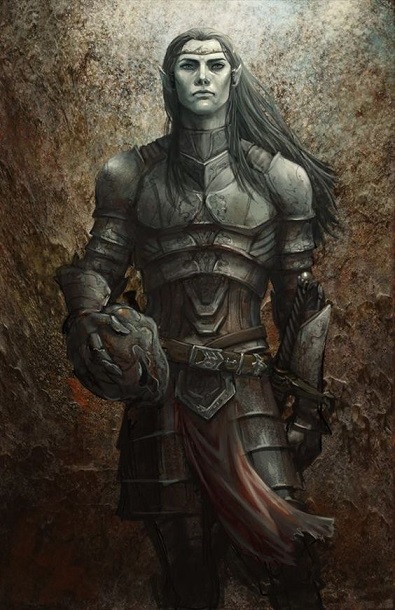
| Category | Fallen Empires | ||||
| World | Bal-Kriav | ||||
| Region | Azrik, Necrocrypt | ||||
| Government | Kingdom | ||||
| Capital |
|
||||
| Population | |||||
| Races |
|
||||
| Deities | Corellon, Melora | ||||
| Enemies | First Khazarkar Empire | ||||
| Reign | 299 - 1029 | ||||
| Maps |
|
On 14 Temporal 299, the people of Andrithiach instituted a monarchical system of governance. This decision aligned with the tenets outlined in the Gwildath Bureaucratic Codices, mirroring the practices of their forebears in Celanil and the greater Gwildath region.
In the western region of Azrik, the empire enjoyed a period of peace and prosperity, engaging in extensive trade with their Tragaran neighbors. However, this tranquility was disrupted by the rise of the First Khazarkar Empire. During the Domination Wars (995 - 1016), they suffered losses from magical storms and a land torn apart by unrestrained magic. This Gulimbor Cataclysm (996 - 1203) led the Melephaeusans to join what became known as the Great Exodus. Most Melephaeusans fled northward into Cal-Thaoun land, taking ships to the isle of Gathrot.
Naval passage and ships were exceedingly costly during the era of the Great Exodus. The overwhelming demand of individuals seeking to depart Gulimbor far surpassed the capacity of the harbors within the Rogue States.
Ermikel the Balance - "The Great Exodus"
Aboard the vessels of Cal-Thaoun and the Ivory Asylum, Melephaeusa's refugees journeyed northward to the largest island that would later be recognized as Necrocrypt. The choice to establish their civilization on islands once governed by the Durkoth and one of their Saints was largely orchestrated by a long-serving, highly esteemed civil servant named Caliguworm. Seeking the admiration of a power greater than the ministers and leaders of his kingdom, he heeded the ominous whispers he encountered during his surveys of Gathrot and its neighboring islands, ultimately convincing himself that Gathrot would best serve his people.
On the Isle of Gathrot, the Melephaeusans reoccupied an ancient, overgrown ruin. Remarkably well-preserved against the elements by magic, this structure had served as the capital city of the Abâthigûr Empire ( 862 HE - 1011 HE ) two millennia prior.
The settlers faced several dilemmas while rebuilding the city of Phanêthil. One issue was how to handle the occasional wandering zombie or skeleton. Some advocated eliminating them, while others argued that the burial customs of the long-gone Abâthigûr should be respected, allowing the mindless, non-hostile undead to roam unimpeded. Another challenge was the discovery of gnarled staffs in the ruins, magical defoliation weapons that their previous owners had employed to keep the jungles at bay. Nearly a third of the Melephaeusans opposed using these nature-destroying tools, but they ultimately utilized them to quickly clear the jungle and open land for farming. These decisions, along with other factors, gradually led to dissension among a people once tightly bound by the bureaucracy of the Gwildath Bureaucratic Codices.
... beyond the ruin's alien architecture, what I'm informed is of the Horgon style, the most unsettling aspect of the area are the colossal, ornate structures. They resemble grand mausoleums, yet once functioned as seats of power. My cousin's division, tasked with clearing the labyrinth, conveyed that beneath each of these mausoleums lies a vast, empty crypt.
Dúrildir, the industrious agent of Jungle Defoliation, Team 6, pondered, "Whither have they ventured?"
In 1018, dark whispers guided the renowned civil servant Caliguworm to the Spire of Molakh-Búle. Once inside, he encountered the entity that had been communicating with him since his initial expedition to Gathrot, two decades prior - a newly ascended deity named Thasmudyan. Thasmudyan had long enticed Caliguworm with promises of fame and success, and Caliguworm's ambitions were more than fulfilled, even earning him the highest medal of the kingdom, the "Civilization Preserver." However, Caliguworm now had to uphold his end of the bargain by spreading Thasmudyan's teachings among his fellow Melephaeusans. This endeavor proved challenging, as the people showed no interest in the young deity's promise of eternal undead existence and the practice of necromancy that Thasmudyan openly endorsed. Failing to secure worshippers through conventional means, Caliguworm resorted to a murderous rampage, raising the slain and gradually amassing an army of undead from his own people. These forces were supplemented by terrors from the depths of Mulun'nâth and other undead strongholds. Those with the means, luck, or skill managed to escape Caliguworm's growing legion, fleeing to their ancestral home of Tasartir or joining the cities of Brucrmus in the north. Those unable to escape were left to fill the once-empty crypts of Phanêthil, eventually becoming part of the undead legions of the Black Tide of Thasmudyan as the Phanêthil Division.
By 1029, Melephaeusa had become devoid of the living. Gathrot and her sister islands were collectively known as Necrocrypt, a haven for the undead and a bastion for the Cult of Worms, as well as the religious heart for the Thasmudyan's burgeoning flock.