| Category | Governments |
| Type | Theocracy - Monotheism to the Church of Set |
| State | Khazarkar Empire |
| Leader | Phêrî |
| Formed | 4 Bloom 1027 |
On 4 Bloom 1027, with the conclusion of the Eldritch Civil War (1017 - 1027), a novel governmental system was established within the Khazarkar Empire. The defeated Conclave's magocratic regime was supplanted by a theocratic order.
Before the establishment of church rule and the magocracy, the Khazarkar Empire was long governed by the esteemed Minâth-Nôrî families, the elite aristocratic class. Similar to the era under the Conclave, these powerful and influential families were relegated to a subordinate position. To maintain their status, many were compelled to join the theocracy and partake in the decision-making process.
In 1421, with the Monotheism Proclaimation, the Pharzîmrâth commenced enforcing monotheism devoted to Set. The Salbâth Insurgency emerged from "cleansing" campaigns which, under the pretext of punishing banditry, were pursuing infidels.
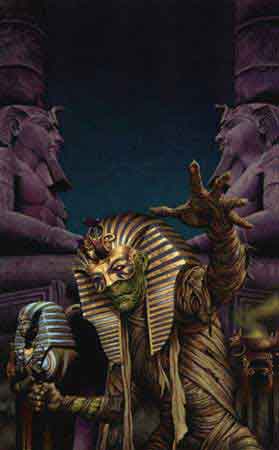
The most senior priest of Set is referred to as a Setarch. This individual serves as the spiritual leader and holds the highest position of power within the Khazarkar Empire.
The Pharzîmrâth's principal offices are situated within the pyramid of Mirandibêth in Nibar-Pharân, the capital city of the Khazarkar Empire.
Like the governments of old, the Minâth are tasked with appointing all positions of authority. The Terrant and Corralum have no voting rights whatsoever. The Minâth establish the binding laws, regulations, and social mores to which the others must adhere, or face harsh consequences.
Zibanalêth, the rebel from Khimilêth - "The Oppressive Caste System".
The Pharzîmrâth is served by a wide array of advisers that are not solely Khazarkar. Elder beholders, illithid, and even Nitthirân can be found within the temple grounds of Mirandibêth.
Malbazân
The Monarchists, or "Malbazân" in Nidurrâb, is a political entity striving to maintain the monarchy's power or reinstate it. When the Pharzîmrâth government was founded, the Monarchists were eradicated, incarcerated, or vanished. Presently, they operate covertly with a substantial following in the empire's western regions. Their paramount objective is to restore the rule of the Minâth-Nôrî families.
Lenassu Dras'ee is one of the most renowned Malbazân. In 1517, she commanded an army against the Khazarkar Empire. This conflict became known as Dras'ee's War (1517 - 1519). Her botched attempt to reclaim her birthright culminated in imprisonment. She was exiled to Ink Hold, beginning a three-century sentence; there, she continues to conspire with the Malbazân.
A group of prominent leaders convenes, representing two factions of power - one based in the east and the other in the west. The Khazarkars of the west, whose lands span from the angel-scarred plain of Âruk to the Core Sea, have factions that desire a more equitable distribution of power or even a return to the ways preceding the theocratic takeover on 4 Bloom 1027. This date is now celebrated across Cinazan as the Day of Set. The western factions promote the notion of rule by the people rather than by the priests of the god Set, though their true leaders are the Malbazân. As a political body, the Malbazân aspire to restore monarchical rule, specifically by the elite families that comprise the Minâth-Nôrî, the highest caste of Khazarkar society.
- from the Godspawn Saga
In the Cinazan Front, they began using the slogan "The West can hold its own." This arose as a consequence of the east withholding their military forces and supplies while the west battled the Flux Pact alone. The politics behind this were only partially accurate. At the time, the east was heavily occupied with maintaining a lifeline to Aphalê and defending the empire's side of the Ugradrath mountains. The Flux Pact controlled the upper Avalninâth river, forcing the Khazarkar Empire to deploy air assets to supply this beleaguered city and help defend against the sneak attack by the Orchish Empire that became known as the Grashakh Front.
Tarkazgir (The Exarchs)
The Tarkazgir is an executive body composed of the high priests bearing the title of Exarch. They are responsible for governing an area of the empire. The Tarkazgir members are drawn from the twenty largest Temples of Set within the empire. The clergy of these temples collect information for the Setarch and serve as local governing bodies for their respective territories. When not preoccupied with governmental matters, they focus on propagating the faith of Set and finding ways to enrich themselves and their temple.
The Tarkazgir are renowned for employing jackal lords in their efforts to undermine organizations, governments, and non-Set religious factions.
| Exarch Name | Governorship |
|---|---|
| Aphalê | |
| Ardilthôr | |
| Arnogrygg | |
| Balmoloch | |
| Benarrân Aphallanâth | Bandunazân |
| Barun-Mitân | |
| Gholompotl | |
| Tanazarân | Hulkurân |
| Mirkathân | |
| Milzanâth | |
| Nibar-Pharân | |
| Nirzanâth | |
| Zigân-Bazar | |
| Zigân-Zadân | |
| Zilkhûn |
Related Information
Notable Departments
- Akumîlû
- Kamrazîr
- Phâte Sûlê
- Phâte Ubrî