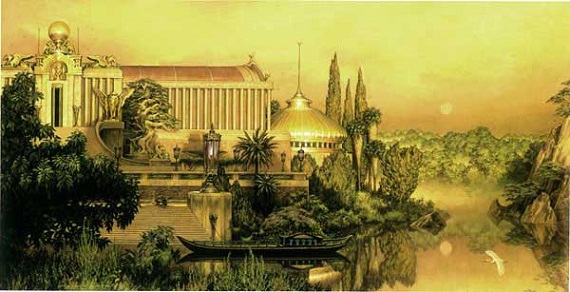
| Category | Fallen Empires | ||||||||||
| World | Bal-Kriav | ||||||||||
| Region | Cinazan | ||||||||||
| Government | Oligarchy (Familial) | ||||||||||
| Capital | Erchinor | ||||||||||
| Population | |||||||||||
| Races |
|
||||||||||
| Deities | Arcana | ||||||||||
| Trade | grain, fruit, wine | ||||||||||
| Enemies | none | ||||||||||
| Reign | 913 - 1830 | ||||||||||
| Map | Darmaer |
Gilraen was established a year after the Ithendelt Schism (905 - 912), the civil conflict that divided the region's Kriavfahliil. The victors, House Ithengee, remained in the lands of Ithendelt, assuming control as the newly formed Kingdom of Ithengee. The exiles, led by House Glorfindel, traveled eastward, to the opposite side of the Core Sea. With the establishment of Erchinor, they founded a government under the name Gilraen.
In 1420, the Khazarkars encroached upon the Gilraen lands. The following year, in 1421, they demanded that the Gilraens submit to vassalage, citing security reasons. This precipitated the Gilraen-Khazarkar War, which ended after merely two months, with Gilraen becoming a vassal state of the Khazarkar Empire. As a vassal, the Gilraens enjoyed considerable autonomy, though they were required to pay taxes, facilitate trade, and maintain the racial integrity of their people, prohibiting intermarriage or mating between Kriavfahliil and Khazarkars. Additionally, they were compelled to exchange military doctrines, scientific knowledge, and other information with their overlords. Regrettably, the Gilraens were also forced to abandon the worship of their primary deity, Arcana. Those who refused to comply faced imprisonment, exile, or execution, leading some to join the ongoing Salbâth Insurgency, which has raged unabated for four centuries. Some even sought refuge within the Eldritch Conclave, finding kinship among the skilled arcanists and those seeking to bring about change within the Khazarkar Empire.
Gilraen maintained a significant degree of autonomy, retaining the coastal region north of Eämbavië all the way to the Cinyossion Valley. In exchange, Gilraen had to be open to sharing their findings, pay tribute, and integrate with an educational system vastly superior to that of their conquerors. This interaction between the races resulted in cross-cultural mingling that some viewed with skepticism. (c.f. Khazarkar Purity Edict)
On the 14th of Lunar in the year 1830, with the capture of its capital by the forces of the Flux Pact (on the Cinazan Front), the Gilraen Oligarchy met its demise. Its displaced citizens then joined the already embattled Khazarkar cities.
The individuals with ancestral ties to this empire are frequently referred to as Gilraens. Significantly influenced by Khazarkar culture, particularly the ideals of the Minâth, they possess an elitist mentality reminiscent of their Gwildath forebears.