| Category | Wars | |||
| Period | 1470 - 1479 | |||
| Theater | Hells Womb, Grashakh | |||
| Belligerents |
|
|||
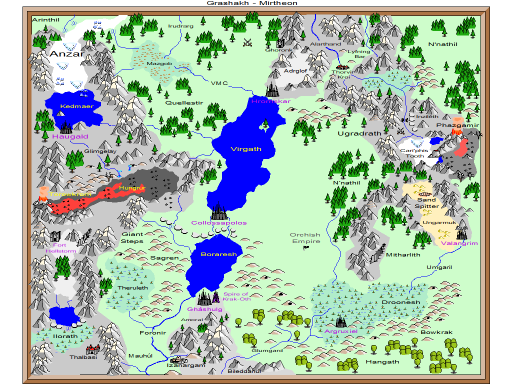
| Maps |
|
Leading up to War
The towering Bileddanul Mountains bisect the heart of the Grashakh Region. Since the tumultuous Demon Spawn War (89 GE - 269 GE), whomever commanded this strategic locale possessed an impregnable stronghold, with all major mountain passes fortified by an array of towers and keeps. Under the watchful gaze of the Gimhak, the trade routes traversing Bileddanul were exceedingly secure, along well-maintained roads with frequent patrols. The Gimhak also guarded the region's flanks, quelling the savagery of Hangath's denizens to the east, and containing the diseased and dire of Mauhúl to the west.
After the establishment of Kotharlarg in 1120, the Orchish Empire advanced northward to the Bileddanul mountains. However, their progress was impeded by their longstanding adversaries, the Badger Legions of the dwarven kingdom of Gimhak. Gimhak, a dwarven monarchy, dominated much of Bileddanul and the surrounding regions, stretching from Sorrow Pass to Gathol, including the area known as Hells Womb.
The Orchish High Command, in the face of their northern expansion into Gimhak, turned their focus to planning their next conquest. They had to devise a way to subjugate a population entrenched in the mountains, with deeply layered defenses, and a population ten times their own. True success in this operation would require coordinated attacks from multiple points, and the severing of supply lines between Gimhak's north and south. Blac'drugulois, the Ageless Emperor leading the Orchish Empire, along with the Court of One Hundred Eyes, opted for a cautious approach. The generals of the Orchish High Command, with shorter lifespans compared to their leader and advisors, favored a year of preparation followed by an all-out assault. Indulging their appetite for battle and bravado, many smaller skirmishes and wars ensued. With the final decision resting with the emperor, they built up their strength, never fully committing their armies to these "adventures".
One of the war documents, on display in one of the Halls of War, chronicles a dialogue between a turncoat spy and a War Maiden, the latter holding a position within the upper echelons of the High Command.
Colonel Lagrash cautioned, "If we expand our perimeter, Gimhak will block our advance."
War Maiden Uzol - Fear not, based on the information I have gathered, the commander has issued orders to besiege Bileddanul.
Lagrash - The entirety of the mountain range? Such an undertaking would be exceedingly costly. Hangath would necessitate 20,000 troops to retain even a precarious grasp, consuming half our available forces.
Uzol - The Ageless Emperor devises strategies that transcend our mortal existence. Historical accounts confirm the efficacy of their endeavors.
from the Lagrash-Uzol Document
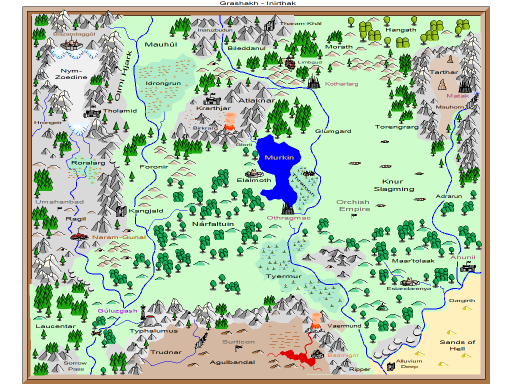
For three centuries, the Orchish Empire centered in Bileddanul, enduring the wrath of Hangath's savage "raiders." Late in the Second Epoch, the southern Black Tide War (1465 - 1486) created an opportunity to divide and conquer. The High Command prepared for a war that would press both Gimhak's northern interests and the southern interests focused on Strumpktar.
Northern War
In 1470, the Siege of Tharam-Khâl commenced. This would be the first of many battles, with Tharam-Khâl changing control ten times by war's end. Izanargam, Gimhak's northern capital, was sacked twice. For numerous years, the issue for the Orchish Empire was an inability to supply and maintain its hold. Conversely, the Gimhak, with their interior lines and formidable fortifications, always had places to retreat to. They faced no shortage of supplies, with numerous foreign providers, and the general sentiment was that the larger the Orchish Empire grew, the more it craved. Gimhak had two methods of supplying its far-reaching territories: a 680-mile subterranean supply line linking Izanargam and the southern capital of Strumpktar, as well as teleportation chambers in each city, enabling the swift transfer of soldiers between north and south.
Southern War
Three months after the siege of Tharam-Khâl, the Black Tide marched northward towards the Sorrow Pass. Their objective was to subjugate the Lands of Purity by traveling north and then west. After battling past the elves of the Gwaeldior Forest, they faced their next formidable obstacle - the forts and towers dotting Gathol, the southernmost defenses of the Gimhak Monarchy. Denied their request to pass through Targind-Nal with an army of 8,000 souls and 3,000 undead, the First Dead offered a million gold to avoid an unnecessary war.
Let us not squander our resources on warfare. Our conflict lies with the lands to the west, as Thasmudyan decrees. The Black Tide shall provide payment for safe passage and recompense for the disruption of war.
Rax, of the First Dead, to governor of Strumpktar - "Prelude to War"
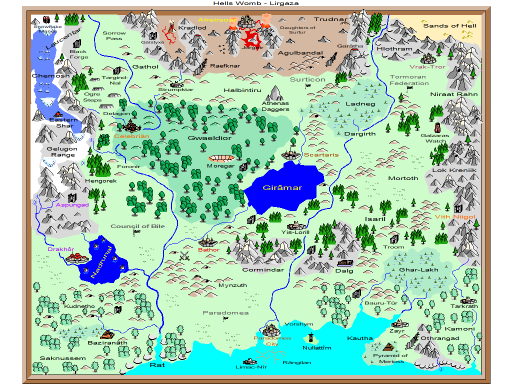
After the diplomatic efforts proved unsuccessful, the First Dead Council liaised with their military attaches, officers embedded within the High Command. These discussions culminated in a military alliance known as the Eye-Skull Pact. With the Orchish Empire assailing from the north and the Black Tide encroaching from the south, Gimhak's southern domain, centered on Strumpktar, became the primary objective.
In the year 1472, the formidable fortress of Targind-Nal succumbed to the Eye-Skull Pact.
In the year 1473, Gimhak's southern capital of Strumpktar was assailed by the Eye-Skull Pact.
In the year 1479, with its government seized or eliminated, the reign of the Gimhak Monarchy drew to a close.
Today, Bileddanul is beset by the dwarven constructs and magical guardians that remain from the era of the Gimhak. The locals assert that Gimhak spectres continue to construct these retaliatory entities, relentlessly fighting for a dominion that they will defend for as long as their supernatural existence endures.
Notable Battles
- Battle of Izanargam
- Sieges of Tharam-Khâl
- Siege of Izanargam