| Category | Ruins | ||||||
| Continent | Karterus | ||||||
| Region | Azrik | ||||||
| Population | |||||||
| Races |
|
||||||
| Founded | 14 Saunas 110 HE | ||||||
| Map | Vetoubahr |
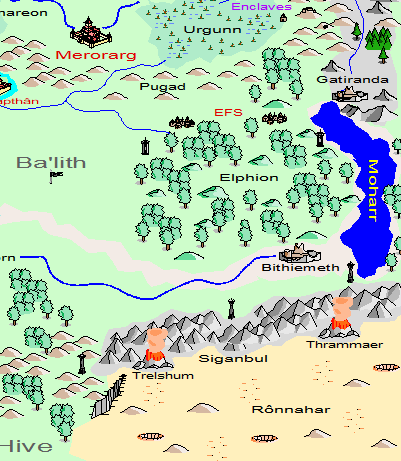
Situated at the southern tip of the Moredhel Valley, Gatiranda commenced as a mining outpost, safeguarding the interests of Merorarg's merchants. Its prosperity stemmed from logging, mining, and the shipment of these goods back to Merorarg. In 1211 HE, Gatiranda seceded from Merorarg's control, becoming an autonomous city-state. This was a bloodless transition, as the heads of the mercantile boards in each city also served as the de facto governmental leaders. This was due to the fact that 80% of the government's operating funds originated from commercial activities. The two leaders reached an agreement by binding their families through marriage, and as was the tradition, they adopted the daughter's surname, Farinteen, as their new family name. They did this solely to put an end to the Alpynan Mercantile Dispute, which had ravaged the economy with high inflation for five years. Now that Gatiranda and Merorarg were independent, the belligerents of the dispute were compelled to settle their affairs through the courts of each city. With Gatiranda's newfound independence, Merorargian Mercantile Law dictated that the newly formed entity must discard its old charter and replace the former mercantile board, which had been dominated by Merorarg sympathizers. The courts ruled that the warring merchants must agree on equal rights of commerce along the Alpynan, thus concluding the long-standing dispute.
In 339, Gatiranda and Merorarg, autonomous city-states at the time, united under the auspices of the Niratar Theocracy.
When friendly contact was established with Andrithiach, Gatiranda became their primary trading partner, with timber, mining ores, and gemstones being shipped northward, while finished products such as furniture, windows, and jewelry were exported southward from their elven neighbors.
Gatiranda evaded the fate of many other Broken Lands settlements, remaining unscathed by the devastation wrought during the Gulibmor Cataclysm (996 - 1203). However, they could not escape the wrath of the Khazarkar Empire. During the Moredhel War (1000 - 1006), Gatiranda was captured by the Khazkars. As a lesson to other cities in the region that refused to become Khazarkar vassals, the city was razed. It is said that several hundred, trapped by the enemy's cordon, fled southward, plunging into the frigid waters of Moharr. The northern shores of the lake are allegedly haunted by their lingering spirits.
As the Khazarkars maintained control of the area, they prevented resettlement. Consequently, most Gatirandans, citizens of the Niratar Theocracy, became part of the growing Great Exodus (998 - 1017). They traveled northward to Andrithiach and then onward, becoming refugees of the Cal-Thaoun Dynasty. In refugee camps, they awaited passage to the Lands of Purity, Niratar's resettlement site. A few thousand remained in the region, heading west into the often hostile territories of their neighbors, the minotaurs. Some became slaves, while others became citizens of the Ba'lith Empire. Meanwhile, others journeyed northward, joining the Torgilm Confederacy (1475 - 1719).
The half-elves of Gatiranda were the result of amicable relations between the Tragarans and Kriavfahliil. Though they did not always receive equal treatment, numerous half-elves ultimately resided within and around the region of Gatiranda.
Today, the ruins of Gatiranda now harbor bandits, monsters, and other predatory entities.