| Category | Cities | ||||||||||||
| Continent | Brucrumus | ||||||||||||
| Region | Lands of Purity | ||||||||||||
| Owner | Malacost | ||||||||||||
| Population | |||||||||||||
| Races |
|
||||||||||||
| Founded | 5 Hollow 125 GE | ||||||||||||
| Map | Adellum |
Iglutt, the oldest city in the region once known as Phiyel, has witnessed the rise and fall of countless civilizations over the course of many millennia. This sprawling metropolis, expanded and fortified throughout the ages, now contains vast, walled-off vacant areas to deter predators. At the heart of this urban expanse lies a Covenant Holy Bastion, one of the many command and control centers built during the God Era to confront the demon hordes spilling forth from the Abyss, as part of the Covenant.
The imposing Iglutt citadel, a testament to dwarven craftsmanship, was constructed by battalions under the command of Naraz-Nâru. They named this fortified stronghold in honor of one of their fallen leaders, whose son perished early in the Demon Spawn War. Beyond its role as a vital Covenant base, Iglutt also served as the administrative center for the Quara'tun Judges.
Iglutt is situated in the upper eastern half of the Slafknara forest. At an elevation of 3600' above the Pearl Sea, it is surrounded by towering evergreens, all thriving on a bed of nutrient-rich volcanic soil. During the Lith-Crillion Era, Mt. Bophungad typically erupted northward, occasionally engulfing the valley in fire and molten lava. By the Horgon Era, the volcano's explosive activity had naturally shifted southward with the sinking of the Guleddab basin. Since that time, those inhabiting this ancient locale have prospered in their agricultural pursuits.
Today, many of the city's inhabitants are descendants of those who sought refuge here during the Black Tide War (1465 - 1486), hailing from Vraga Moltus, Phanax, and other towns and villages that once pledged allegiance to the Farinteen crown.
The First Wall
Iglutt has a storied past of military conflict. It was constructed a thousand years ago, long before the historical records were organized and widely disseminated by Ermikel the Balance. During the First Epoch, the Zarakhâl clan, residents of Narukgulan, built the initial continuous wall surrounding Iglutt. This wall was erected to enclose a town that had been expanding outward from the Covenant citadel. The sturdy sixty-foot-high wall has an equally thick base, with blocks quarried under the threat of stone giants and monsters, transported hundreds of miles from the slopes of Gûn.
In 736, the Zarakhâl were vanquished by Apocalypse and his Graagvrii army. Apocalypse then assumed control of a mining town, a newly constructed wall, and the venerable Covenant bastion, which became his domain. The surviving Zarakhâl retreated into the subterranean tunnels beneath the great hall Taram-Bulak, disappearing from sight.
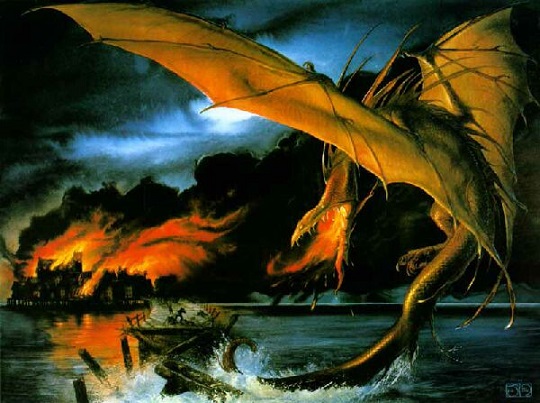
A decade later, a sizable tribe of goblins arrived in Iglutt in search of new living accommodations. To them, the place appeared dilapidated, with its new owner spending substantial time in slumber and his former army disbanded due to financial constraints. Much like the Graagvrii, these goblins soon succumbed to worshiping Apocalypse. Over the ensuing 300 years, the dragon and the goblins accumulated a vast hoard of treasure. The goblins christened themselves the Great Host of the Wyrm. Today, the Great Host of the Wyrm comprises the tribes - Black Tongue, Bone Hand, Vulture Sons, Pack Rats, and the Crimson Nails; dwelling within Anjald's deep crags behind extensive cave networks, they number in the tens of thousands.
The goblins constructed a massive circular structure near Taram-Bulak to serve as a temple for their deity, Apocalypse. This granite, iron-reinforced building is known as the Iron Dragon. Today, the Iron Dragon stands as the seat of power for the council rulers of modern-day Iglutt. An engineering marvel that surpasses typical goblin capabilities, the Iron Dragon stands 400 feet high and 300 feet in diameter, buttressed by heavy iron beams. Its inner chamber measures 150 feet in diameter with a lofty 100-foot ceiling. The structure features two grand chutes that once served as entry and exit points for the dragon's great mass. During the Black Tide War, the Iron Dragon served as the headquarters for the Scourge of Athena.
The Second Wall
In 1064, Iglutt was assailed by a formidable firbolg army numbering a thousand strong. This bellicose horde, driven by a lust for war and encouraged by war priests serving Ares, had carved a path from Hengorek to the lair of a dragon in his twilight years. Apocalypse, sodden with age and gluttonous from easy victories, proved no match for the forces that converged upon him. Led by a commander reminiscent of his own youthful prowess, Apocalypse was brought low by a hailstorm of arrows. Chieftain Naggor, the firbolg commander, had led his band of Bushwhackers hundreds of miles, plundering and burning villages and forts along the way, and now laid siege to the ancient dwarven walls of Taram-Bulak for three months. The goblins, succumbing to hunger and loss of morale, capitulated. The tattered remnants of the Great Host of the Wyrm, reduced to several hundred, were then enslaved by Naggor's army. Later that same year, Iglutt became the capital of the newly formed Kingdom of Naggor.
Under Naggor's reign, the firbolgs constructed the city's second great wall. These towering bulwarks stand as the highest battlements in the city, soaring 150 feet above the streets below. Designed for giants, with openings both tall and broad, the wall is a masterful feat of craftsmanship, some even claiming to rival the colossal cities built during the Titan Era. Although much of the arduous labor was performed by slaves, the structure remains solidly built. The design, oversight, and engineering work of Iglutt's second wall were undertaken by the Grey Masons, stone giants who also oversaw the construction of Gudgrid and whose ancestors built the great sea fortifications of the Titan's Triangle.
The Third Wall
In 1126, Naggor's vast slave population rebelled against their oppressors. They were emboldened by a large Tungesti army, which crushed the kingdom's border outposts and each larger force that confronted them. These Tungesti hailed from the Iraktharbhun Valley. Like the kingdom's firbolg, the free citizens, the Tungesti raiders were devout worshipers of Ares. Worshipping the same deity does not always foster friendship, especially not for a God of War. What matters for Ares is the manner in which one goes about it. The Tungesti's battle priests claimed that Ares was displeased with Naggor's people and their soft, sedentary ways of farming and city living, and thus they must be re-educated in the ways of their shared god.
Iglutt's Second Wall is often blamed for the downfall of Iglutt and the Kingdom of Naggor. It was so expansive that it could not be fully garrisoned, with Naggor's personal chronicler frequently mentioning the king's complaints about the population's slow growth. Due to substantial maintenance costs, the walls were poorly cared for, making them easily scaled by those accustomed to living in the mountains. The Kingdom of Naggor met its end when their long-reigning king perished in the central hall of the Iron Dragon. He was surrounded by the bodies of a hundred Tungesti warriors, with his slayer, a storm giant named Dranfulmus, standing over him. The conquerors loathed the man but honored his combat expertise by erecting a towering 100-foot statue of a giant red sword. This became the Red Sword monument, a war shrine dedicated to Ares.
Guided, but not led, by the titan Dranfulmus, the Tungesti governed Iglutt for the subsequent four centuries. Like their predecessors, they felt compelled to this venerable locale, relinquishing some of their marauding and plundering to establish a nation. In 1127, they founded the Targad confederacy, one of numerous Tungesti tribes, with Iglutt serving as its capital.
Iglutt's Third Wall was constructed by the Targad. The wall exhibits a considerable breadth, with heights akin to the undulating crests of a mountainous terrain. The expansive summits of these distinctively wide walls functioned as both fortified battlements and bustling commercial thoroughfares, wherein the majority of Targad's Tungesti populace resided.
Targad maintained control of Iglutt until the year 1531. In this time, the Shields of Iraktharbhun assumed authority over the city. To avoid submission under the governance of non-Tungesti, the majority of Targad's populace migrated eastward to their ancestral domains within the Iraktharbhun Valley.
During the Black Tide's control of the Lands of Purity, Iglutt evolved into a heavily fortified city-state with numerous political factions. It served as the epicenter of resistance against the Black Tide of Thasmudyan. Following the Athenian Crusade (1539 - 1551) and the Black Tide's defeat, Iglutt's population declined by half as many inhabitants returned to their liberated lands and homes.
Today, Iglutt's Third Wall is a gleaming, pristine white, adorned with captivating images of angelic figures, majestic silver and gold dragons, and the enchanting fey of the Sylvan Kingdoms, all recounting the harrowing tale of the Black Tide War.
When the Country of Malacost was founded, Iglutt emerged as one of its constituent states.
Notable Areas
- Beard Trail
- Iron Dragon
- Red Sword
- Taram-Bulak
| Covenant | ||
| Iglutt | ||
| Narukgulan | ||
| Kingdom of Naggor | ||
| Targad | ||
| Malacost |