| Category | Wars | |||
| Period | 1795 - 1800 | |||
| Theater | Ma'Ohari, Sea of Mourning, Buccaneer Archipelago | |||
| Belligerents |
|
|||
| Maps |
|
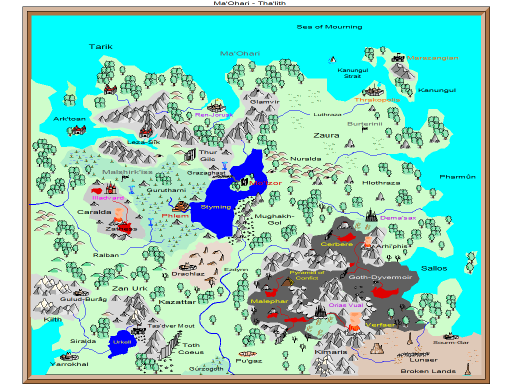
For centuries, the Burterinii of eastern Ma'Ohari, and Bloodtusk with holdings along the western coasts, were at odds. This conflict began after the rise of the Bloodtusk Regime in 1465, an empire ruled by the ghoul king Jairall Bloodtusk. His connections with the Black Tide and the Dead Council were well known. In 1465, reports from Hells Womb revealed the success of the dark forces prosecuting the Black Tide War (1465 - 1486), the neutrality of Paradomea, and the heinous depredations visited upon the land. As a result, the Burterinii's leaders were cautious, sending diplomatic missions to the new king without success. Over the next three centuries, small battles and full-blown wars followed, but they never established any sort of peace. During this time, pirating the Buccaneer Archipelago became a serious profession, with pirates preying upon both sides and sometimes joining them if mercenary pay exceeded booty looted from pirating.
By 1795, the Burterinii empire had grown to be of remarkable military might and substantial wealth. Meanwhile, the Bloodtusk Regime had stagnated from internal discord and ceaseless skirmishing with not only their closest neighbors, but also those more distant, Ba'lith to the south, Ivory Asylum to the west, and with Paradomea, the Council of Bile, and Malacost of the Brucrumus mainland.
The Burterinii forged an alliance with around a dozen pirate groups from the Buccaneer Archipelago. This military pact became known as the Burterinii-Buccaneer Alliance. Together, they mobilized their fleets for an attack on the Bloodtusk Regime. With over 700 ships, the armada that confronted Bloodtusk was the largest mobilized since the Demon Spawn War. It was a diverse force, a quarter of it comprising mercenary units from Ivory Asylum, Paradomea, and the Council of Bile. The Ghul Armada was no match for the sheer size of the navy that engaged them. In the Battle of Cape Tarik, the Ghul Armada was all but annihilated. The Armada of the Damned and the remnants of the battered fleet fled westward to defend Salandirik.
Ren-Jorusk was relentlessly bombarded by ship-mounted cannons for twelve days. The defenders retaliated with their own shore batteries. However, their mortars and cannons fell silent on the fourth day of the bombardment. The troop ships of the Burterinii-Buccaneer Alliance then landed and commenced a lengthy siege that lasted seven months. Even after the city's capture, the attackers had to contend with guerrilla fighting in the surrounding hills and jungles. Secured in the final months of 1796, Burterinii stationed a garrison there. This was followed by a six-month lull in the conflict, caused by disease outbreaks in the city and fleet. Sanagar-Umlâs, a cult known for fomenting such calamities, and allied to neither side, was found responsible.
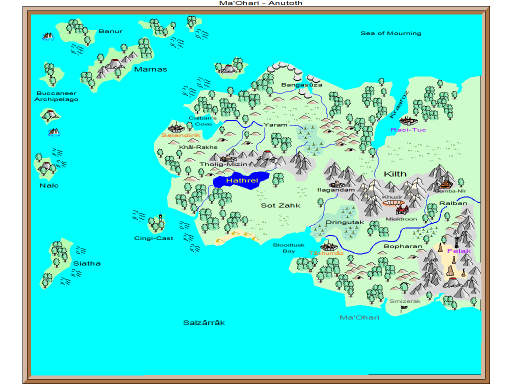
In 1797, the allies captured Raci-Tuc. They then planned an overland march towards the enemy city Salandirik. The treacherous interior of Anutoth, known for disease and hostiles, was too perilous for a direct route to the target, so they undertook an even bolder risk. They deployed barges and other craft at the mouth of the Bangasûza fjord. It was later discovered that the Scrag inhabitants of the area had been persuaded by a powerful druid not to attack the trespassers. Interestingly, a year later, the druid Beldirothe, herself a scrag, was appointed as the Nature Protectorate of the Ma'Ohari region.
The allies departed Bangasûza and journeyed to the Yaram river. A fierce battle was waged there. Bloodtusk's forces were entrenched on the southern bank, defending the overland approach to Salandirik. They were fortified behind extensive defenses, built over centuries to suppress the local scrag. The Battle of Yaram River was a bloody conflict, with the attackers requiring transport by barrage under the relentless fire of the well-prepared defenders. The tide turned in favor of the attackers when another army was deployed south of the defenders. This occurred only after a naval action that saw fifty ships sunk in Calban's Cove. The Alliance's navy bombarded the defenders as they were assaulted by the disembarked Anvil Group; an army of pirates, mercenaries, marines, and infantry. The two armies north of the defenders, codenamed First Hammer and Second Hammer, pressed the foe. After a week of fierce combat, Bloodtusk's forces were defeated. Thousands of bodies drifted along the Yaram's gentle flow towards the Sea of Mourning, many dragged into the depths by hungry sahuagin or the hundreds of ghouls that had escaped Bloodtusk's masters.
The Alliance launched an assault on Salandirik. The siege lasted five months, with the city falling late in 1798. War journals from that time recount the defenders catapulting disease-ridden corpses and ceramic jars containing green slime and black puddings at their foes. The city also commandeered private merchant ships, transforming them into fire ships manned by undead "suicide crews," which inflicted greater losses on the blockading fleet than cannon fire and ship-to-ship combat. When the city walls were breached, the living were spared, but no quarter was given to the undead. Thousands of undead soldiers and their leaders fled through tunnels leading into the Khâl-Rakhs hills, then marched overland to join those at Ivory Ward.
In 1800, a monumental naval battle unfolded in Bloodtusk Bay. In this action, Admiral Bloodtusk commanded from the ominous vessel Godhead's Revenge. This fearsome warship and its Armada of the Damned inflicted severe damage on the Alliance fleet. Any single ship from this lethal armada could have easily prevailed in a four-to-one battle, but the Battle of Bloodtusk Bay was a staggering 20:1 engagement. Late in the protracted conflict, Bloodtusk's fleet was bolstered by minotaur mercenary ships sponsored by Ba'lith. Even with this additional support, Bloodtusk's formidable navy was ultimately destroyed, with the admiral and king perishing alongside his flagship. Following this pivotal naval battle, the Alliance fleet proceeded to bombard Ivory Ward before storming the city. The Siege of Ivory Ward endured for four months, culminating in the fall of Bloodtusk's capital on 19 Lunar 1800 and the demise of the four-century-old Bloodtusk Regime.
Related Information
Notable Battles
- Battle of Bloodtusk Bay
- Battle of Cape Tarik
- Battle of the Yaram River
- Siege of Salandirik