| Category | Fallen Empires | ||||
| World | Bal-Kriav | ||||
| Region | Lands of Purity | ||||
| Government | Autocracy | ||||
| Capital | Vraga Moltus | ||||
| Population | |||||
| Races |
|
||||
| Deities | Athena, Atlas, Phalgas | ||||
| Enemies | Black Tide of Thasmudyan, Ba'lith, Garormuk, Targad | ||||
| Reign | 1017 - 1486 | ||||
| Map | Adellum |
In the Great Exodus (998 - 1017), a substantial migration of peoples departed the beleaguered lands of Karterus for the Brucrmus mainland. Those who ventured to the far eastern regions of Brucrumus, a perilous 2300-mile ocean voyage, settled in the Adellum Sector. Primarily, these individuals were refugees of the Niratar Theocracy, a nation on the brink of collapse. Crossing uncharted waters, overcrowded ships, and an ever-increasing threat of pirates, the large-scale movement of ships across a vast area resulted in significant losses. One of the most devastating events for Niratar was when nearly half of its leadership, including high priests of Athena, Arcana, and Kebechet, were murdered in the waters and on the fog-shrouded shores of Masked Landing. This organized attack was carried out by twelve ships with holds full of sociopathic assassins and loot-hungry pirates, all funded by the cultists of Demogorgon. The reason for this assault was revenge against the goddess Athena, a Covenant commander who had caused Demogorgon trouble during the Demon Spawn War.
Those who reached Adellum focused their settlements along the coastline at Vraga Moltus. This storied city, founded in 1015, became Niratar's new capital. Two years later, after much deliberation, the populace voted to change their system of government. They opted for an autocracy, replacing Niratar's centuries-old theocracy. This shift in public opinion was attributed to the Great Exodus and the widespread belief that the gods had not done enough to aid them in their greatest time of need. The Farinteen family was selected to lead the people. The Fartineens, descendants of Lagad-Bast, a Krotoan sub-commander under Lukoon during the Demon Spawn War, supplanted the theocracy with an equally long-lasting hereditary rule.
Farinetian society was constructed upon sturdy laws and racial parity. Emerging from the Niratar Theocracy that came before, it possessed a religious zeal that consistently intensified amidst the conflicts that ensued the Tragaran expansion into novel territories.
The Farinteens aggressively expanded their frontiers with the goal of bringing civilization and religion to Phiyel's interior. Phiyel, a vast region, came to be known as the Lands of Purity under Farinteen control. The prominent churches were those of Athena, Atlas, and Phalgas. The backbone of the empire's army comprised the formidable Lances of Merioss.
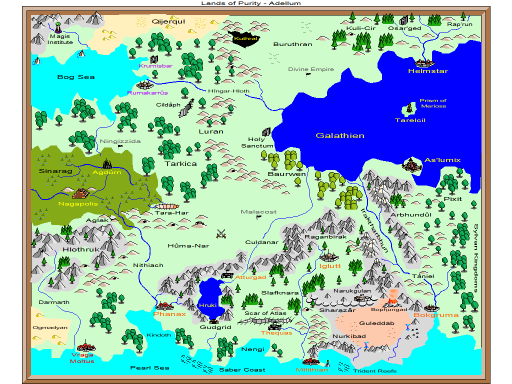
Late in the 1060s, Farinteen's northern expansion, including settlements, mining claims, and strategic interests, led to conflict with the natives of Sinarag. These natives were yuan-ti, Lorhazi, greenies, and Graagvrii, generally supported openly or secretly by the city-state of Nagapolis. This conflict resulted in a chain of towers, forts, and imposing castles constructed from the Aglak Rampart to the bowels of Tara-Har. While the empire battled yuan-ti slavers and agents of Nagapolis, another conflict commenced north of Vraga Moltus. In this area, goblins and Zog-Nee barbarians emerged from the Hlothruk Mountains, plundering and pillaging Farinteen frontier settlements.
Expansion westward past the Culdanar River and along the banks of the Galathien proved more tranquil, with amicable relationships established with the local Forstneblin, wood elves, and dwarves. Farinteen's attempts to propagate their religion into these areas precipitated conflicts, though these were minor affairs, eventually culminating in the Articles of the Four Peoples. These laws and guidelines for peace and prosperity addressed religious tolerance, self-determination, and other concerns such as freedom of movement, banking, and trade. These Articles would form the foundation for Farinteen's successor, the nation of Malacost. In addition to the local Lands of Purity, Farinteen maintained robust trade and mutual defense pacts with the people of Ivory Asylum.
In the Black Tide War (1465 - 1486), the undead armies of the Black Tide of Thasmudyan advanced westward from Hells Womb into the Lands of Purity. The Farinteen Alliance was gradually pushed back. General Garn, a leader of the Black Tide, secured Ebonstar and deployed armies into Hlophar-Maur. Another lich leader, Katrana Dumu-loc, marched south across Galathien, wreaking havoc in the Sylvan Kingdoms. By sea, Admiral Jariall raided the empire's coastal holdings. Pinth, supported by dwarven mercenaries from Naram-Gunal, bolstered Garn's advance. The Hlophar-Maur Breakout was followed by many more legendary battles, such as the Luran Campaign and the Siege of Vraga Moltus. In 1486, Vraga Moltus was captured, ending Farinteen rule. Those fortunate enough to escape fled eastward into the Raganbirak highlands, battling Targad for a place to live and rebuild their forces.
Following the collapse of the Black Tide during the Athenian Crusade (1539 - 1551) and the subsequent Artery War (1546 - 1554), numerous former Farinteens became citizens of the Country of Malacost.