| Category | Wars | |||||||||
| Period | 1828 - Current | |||||||||
| Theater | Ice Cap | |||||||||
| Cinazan | ||||||||||
| Belligerents |
|
|||||||||
| Map | TOC |
The Cinazan Front was one of the regional wars that constituted a more expansive conflict known as the Chaos War.
On 5 Hollow 1828, the 1st Horde of Chaos, numbering 150,000, mobilized out of Neeth-Theen. They marched south from Hleittil, covering approximately 25 miles per day. Three days later, they were joined by 10,000 troops from Icyke. These two allied forces of the Flux Pact advanced southward in a great pincer movement. The objective of this formidable war machine was to spread chaos throughout Neeth-Theen. The horde was led by the black slaad Ushgergoon. Icyke had joined the Flux Pact to settle old scores with the Khazarkar Empire.
The army of the Neeth-Theen consisted of creatures of chaos; crawling, flying, slithering, deformed, and such aberrations as have never been witnessed before on Bal-Kriav. Icyke moved many of their troops in steam-driven ships, rolling on great iron wheels, passing over land in lieu of water. The reason for these contraptions was to avoid the great navies of the Orchish Empire and the Khazarkar Empire. Both of these empires considered such a large force coming south to be hostile. When both empires sent emissaries to ascertain their intent, they were essentially informed that they come to conquer everything in their path. As aggressive empires themselves, both decided it was prudent to take the war to them before they reached their borders. From the safety of the river Eldorien, this commenced an intense bombardment of the enemy until they had moved out of cannon range.
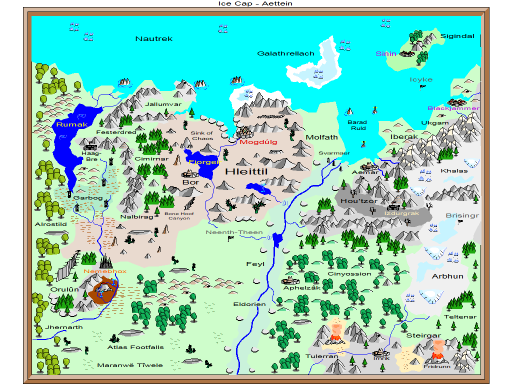
As the armies traversed southward through the region of Cinyossion, the forces of Icyke marched along the eastern side of the Eldorien. After several days of travel, they began sustaining significant losses from guerrilla attacks by the numerous fey inhabitants of the Cinyossion valley. Large groups fell victim to both natural and magical sleep-inducing agents, whereupon they were subsequently slain by treants, sprites, and other fey who seemed to sense the chaos and malevolent nature of the invading force. General Kharash, the Supreme Commander of the Icyke army, ordered the troops to consolidate their ranks, and positioned the land-rolling steam ships to guard the flank against the fey attacks. These imposing vessels succeeded in frightening off the less-intelligent fey assailants, while the more cunning fey were driven back after suffering hundreds of casualties from musket fire, arrows, and canister shot from the decks of the steam ships.
Following an arduous two-month journey spanning nearly 250 miles through the expanse of Cinyossion, the Flux Pact had decisively crushed all jara resistance between the Tulerran and Eldorien rivers.
As the northern border of the Khazarkar Empire drew near, General Kharash of Icyke's army requested that Neeth-Theen join them for a coordinated attack on the Khazarkar vassal state of Gilraen. However, he was rebuked by Ushgergoon, the slaad who claimed supreme command of the Flux Pact. Ushgergoon ordered the general and his troops to cover the Eldorien crossing instead, setting the army on a course towards the lands of the Ithengee. Kharash could only shake his head, knowing the elves of Ithengee were a formidable foe - their wailing towers had successfully repelled the might of the Khazarkar on multiple occasions (cf. Sleepers Battle ).
Siege of Hareldocáno
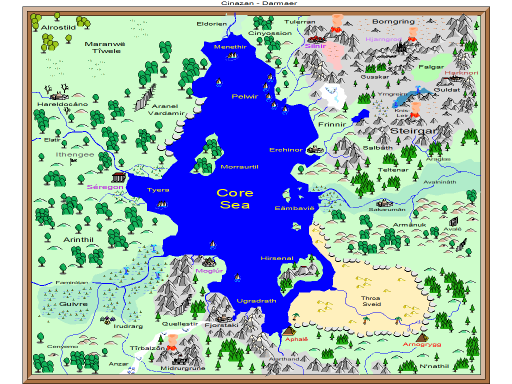
On 15 Lunar 1829, the army of Neeth-Theen sacked the Ithengee city Hareldocáno. General Eälerómë, commander of the Ithengee Defense Forces, deemed the city indefensible against the vast approaching army. The city was left with only the garrison to defend, as most of the city's army and people fled southeast to the Ithengee capital. The Neeth-Theen then marched southeast towards Séregon. Upon nearing this mystical and beautiful capital city, the Horde of Chaos was overcome by the tranquillizing melodies produced by the Maenglórfan. Legions of chaos soldiers fell asleep and were then trampled by their own troops before Ushgergoon ordered a retreat. The loss of nearly 4,000 horde troops without meeting the blade of the enemy caused Ushgergoon to pull his army back to the tip of the Core Sea. The entire army was then ferried back across the Eldorien by Icyke barges and ships. This resulted in a major naval battle that became known as the Menethir Crossing. Where the Core Sea meets the Eldorien, there are marshes and rivers flowing north. This delta is called Menethir. During the Horde's crossing, Rûnê frigates inflicted heavy losses on the barges and ships of Icyke. Many troop transports went to the depths. Oddly enough, very few of the chaos creatures could swim. Over one thousand soldiers of the Horde of Chaos were sent to watery graves.
Idân Campaign
In the region the Khazarkar Empire referred to as the Idân Valley, their Batthurâk forces faced the armies of the Flux Pact in well-prepared defensive positions. Cannon and mortar batteries on the hills rained down iron and fire upon the chaos armies, while Rûnê frigates bombarded them from the Core Sea. The strength of Neeth-Theen's army allowed them to break through these lines after a week of intense combat. The Icyke army fared much worse, suffering over 15,000 casualties due to their inferior armor and the similar caliber of their troops compared to the Khazarkar soldiers.
Siege of Erchinor, Fall of Gilraen
In the second month of 1830, the siege of Erchinor unfolded. This sole city of Gilraen exhibited a pitiful display of defense, lacking in heroism. The Khazarkar Empire dispatched 20,000 troops to aid in the city's defense, but they offered little assistance against the overwhelming firepower brought to bear. During the siege, it was a common sight to witness the sky blackened by the bombardment of giant-sized boulders. This city fell in five days and then succumbed to the effects of Chaos, becoming a Chaos Ruin. The destruction of the city and the massive slaughter of the elven population marked the end of the Gilraen Oligarchy.
Sakarumân Campaign
After the Siege of Erchinor, the Flux Pact traversed the rugged terrain of Salbâth and reached the banks of the Avalninâth River; their objective being the Khazarkar city of Sakarumân.
For eight months (from Temporal 1830 to Witchrite 1830), the Khazarkar Empire engaged the enemy in fierce combat across land, river, and the walls of Sakarumân. In the month of Temporal, the river delta Eämbavië is known for being shrouded in dense fog rolling in from the Core Sea. On 11 Temporal 1830, a thick fog blanketed the battlegrounds facing Sakarumân. Utilizing the cover of the fog, state-sponsored assassins of the Khazarkar Empire infiltrated enemy camps. Cuttenpurr, a renowned rakshasa assassin, and others of the Kamrazîr, stealthily eliminated their targets - General Ki'tear, leading the Flux Pact, and General Kharash, commanding Icyke's armies. They recovered the bodies and neutralized several other high-ranking members of Kharash's forces. Icyke's military was left in a dire state, with over half their strength depleted from the war and the loss of some of their best commanders. To replenish their army, Icyke instituted conscription in their homelands and began hiring mercenaries at lucrative rates. Olugra, the stone giant leader of Geb Vanguard, was hired as the leading general of the Flux Pact, ultimately answering to Ushgergoon.
The grandest spectacle of the Sakarumân Campaign occurred when a Pyramid of Set materialized over the river and commenced a prolonged barrage upon the barges and pontoon bridges utilized by the besiegers. Following six hours of ceaseless bombardment, the void craft was ultimately boarded by airborne chaos minions and a squad of emerald slaadi, the latter mounted upon fearsome dread vultures. Nearing capture, the vessel's captain detonated the magazine, plunging the smoking wreckage into the river. The remnants of this cataclysmic event remain visible even now.
Sakarumân fell on 22 Witchrite 1830. The city was almost completely devastated by the chaotic energies that trailed the Horde of Chaos. The conflict within the city raged for a week, leaving the streets strewn with nearly 30,000 bodies. The prolonged battle exacted a substantial price on both factions, with Icyke sustaining 16,000 casualties, Neeth-Theen 20,000, and the Khazarkar Empire 35,000 losses.
Cinderfall Breakout
The forces of the warded region of Anubeth broke out during the Sakarumân Campaign. The people of Tamlêrran, the lands north of Anubeth, sent emissaries to the major capitals of northern Brucrumus. They informed the capitals that late in the previous year (1829), the Chaos Malestrom had ruptured the Elemantum Boundary Ward on the southern border of Igas. The missive also stated that as long as the breach remains open, the Cinderfall will be free to leave the region.
The Chaos Maelstrom persisted over Nautrek, causing the freezing of a substantial portion of the sea This resulted in the formation of a land bridge between Anubeth and Brucrumus A formidable army of Cinderfall, commanded by the Ebon Princess, traversed the frozen expanse, laying siege to the capital of Neeth-Theen
This led to a meeting between the Flux Pact leader Ushgergoon and the Cinderfall commander. Tempted by promises of gold and magic items, the Ebon Princess's army was enticed into joining the Flux Pact. This force of fiery creatures then marched to the front. Along the way, her fire giant priests of Surtur and Cinderfall ambassadors met with those seeking to settle old scores with the Khazarkar Empire, the people of the Fangs of Steirgar, and others eager for war and plunder. After two months of diplomacy, the Cinderfall coerced two of the Hlimi Kingdoms into joining the war. However, these three armies would arrive too late for the Siege of Sakarumân.
Armânuk Campaign - Year 1830
Following the downfall of Sakarumân, the Flux Pact proceeded to the fortified hills of Armânuk. The Batthurâk General Staff had readied Armânuk as a location to harass the flanks of the Flux Pact as they moved westward towards Nirzanâth. The Cinderfall strategist persuaded their erratic allies that it would be imprudent to leave Armânuk unattended on their flank and rear.
The battle for Armânuk evolved into an extended siege. Over the course of two months, the combatants suffered horrific casualties. The area remained perpetually shrouded in smoke from the cannons, and the sounds of combat emanated from all directions as wave after wave of attackers were hurled against the entrenched positions. Nearly 100,000 Batthurâk soldiers were dispersed across the hills. This force was supplemented by a substantial mercenary contingent comprising twenty Sôldanguk units from the Giff League, thousands of giff mercenaries, and a Gurë legion. This unit of Warforged soldiers was transported from Vorangrith. As the battle progressed, Khazarkar necromancers maintained the ranks by raising some of the fallen as undead. In general, giff are averse to seeing their dead desecrated, so the necromancers moved and resurrected the giff dead in an area distant from the living giff.
During the Battle of Armânuk, the Batthurâk dispatched the Nazôrdâk and two Pyramids of Set into the Fangs of Steirgar. This elite expeditionary force assaulted the lightly garrisoned castle of King Thjollod (cf. Hlimi Kingdoms ), slew his wife, and absconded with much of the King's treasure. Khazarkar mages then enacted Rituals of Ruin upon the great throne room. After an hour, the magic brought down the ceiling. Queen Oggorknot Thjollod's head was taken to Armânuk's highest point and displayed on a pike. Seeing this, King Thjollod flew into a rage, sending his entire force, unsupported, against the Khazarkar lines. This force of 850 troops was utterly decimated. Among the fallen were all of the King's four sons. King Thjollod reached the pike, whereupon the commander skewered the giant with it. This weapon became a trophy of the war, later known as the Queen's Head Pike. The demise of King and Queen Thjollod marked the end of the Kingdom of Thjollod.
On the night of 19 Kindle 1830, the Batthurâk withdrew their main force using giff platforms, Pyramids of Set, and subterranean tunnels beneath the hills. Delaying forces of warforged soldiers and undead were left behind to hold the lines. Armânuk was captured that morning by the Horde of Chaos. Over two months of conflict, the Flux Pact suffered 35,000 casualties, while the Batthurâk lost 22,000 troops.
Armânuk Campaign - Year 1831
For the first six months of 1831, there was a lull in combat as the winter was unusually frigid with heavy snowfall. The spring that followed brought a remarkably powerful monsoon season, drenching the region with double the normal rainfall. Disease ran rampant through the Flux Pact, claiming 6,000 lives. The Khazarkar, accustomed to the monsoon season, fared much better, losing only several hundred to flooding and illness. During this time when the environment was proving more lethal than the enemy, the fire giant king of Xornsnous made a move against an old rival. He returned home with his finest legion, intending to seize the territory of the Thjollods, also an ally of the Flux Pact, while they were engaged in battle. Upon learning of the fire giant king's betrayal, the Ebon Princess caught up with him, beheading him before his own legion. Thereafter, she presented her son, a half-fiendish fire giant, as the new king of Xornsnous.
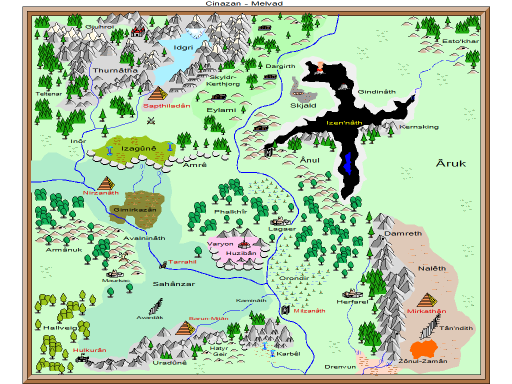
When the weather cleared, the Flux Pact marched eastward, following the Avalninâth River. Their advance was paralleled by the Batthurâk on the river's southern banks. The Pact's eastern push then turned north to the ancient titan settlement of Sapthiladân. Upon seeing the enemy's approach, several thousand civilians fled the city. Tragically, these unfortunate souls were cut down by long-range scouting parties and fire giant raiders from Thurnâtha. The Giff League and the Khazarkar Empire evacuated what they could by air, but this effort ended after the loss of a Giff Platform to enemy air units.
Siege of Sapthiladân - Year 1832
On the 28th of Brightstar in the year 1832, forces of the Flux Pact led by the mercenary general Anutrax laid siege to the Khazarkar city of Sapthiladân. The highly defensive terrain of the city and its nearly impregnable walls drained the attackers of nearly 30,000 soldiers. The Khazarkars, however, had far fewer in number. The siege of this great city and the many battles fought around it persisted for four long months. During the battle, Khazarkar spies learned that the Eldritch Conclave had secretly joined the Flux Pact. A high-ranking colonel of this much-maligned group was captured and interrogated. It was discovered that the Eldritch Conclave had sold Entropy Fragments to Neeth-Theen, which they then used to create an Entropy Arch.
On the night of 7 Witchrite 1832, the Pillar of Horns arrived over the Sapthiladân. This colossal vessel, a veritable floating castle, descended into the city and deployed an Entropy Arch at the very core of the metropolis. This device immediately unleashed its chaotic energies upon the city, followed by a shockwave that reverberated to the northeast. This wave of chaotic forces leveled a substantial portion of the city's structures. The blast continued into the highlands, gaining such potent chaotic energy that it blew a section of the mountains from their foundations, creating Skyldr-Kerthjorg. The city fell the following day. The slaughter of nearly an entire city population had not occurred on such a scale since the Black Tide War ( 1465 - 1486 ) . Over 170,000 Khazarkars and their allies perished in the city, while the attackers lost a little less than 25,000 troops. Thereafter, Sapthiladân became the heart of military operations for the Flux Pact.
First Battle of Inôr
At the First Battle of Inôr, the Khazarkars were aided by the Pillar of Horns. Half of the greatly diminished ranks of the 1st Horde of Chaos, under the command of General Anutrax, alongside the Geb Vanguard, marched southward to confront a Khazarkar relief force advancing north in an attempt to reclaim Sapthiladân.
Other Factors
At the dawn of 1831, the Orchish Empire capitalized on the setbacks plaguing the Khazarkar Empire. The Batthurâk were cognizant of the Orchish troop concentration around Moglúr but lacked the means to impede the enemy's crossing of the Alarthand river. This was due to the majority of the Batthurâk's western forces being engaged against the Flux Pact. As the Druog army undertook the perilous river crossing, the Cyclops Harbor Cannons and other artillery batteries of Aphalê inflicted a devastating toll upon them.
Under a constant barrage, even a near miss poses a grave peril. These Cyclops rounds, fired from cannons requiring a team of colossal artillerymen, create mighty splashes when they land in the river, sweeping soldiers off the pontoon bridges and into Alarthand's tumultuous current.
Private Tak, of the Druog, 2nd Regiment, 4th Platoon - "Aphalê Crossing"
While this confrontation was unfolding, a significant naval battle transpired on the Core Sea between the Khazarkar Rûnê navy and the Orchish Fothakith navy. The Khazarkar emerged victorious in this engagement, driving the orc fleet back into Moglúr's formidable naval defenses. This battle provided the Orchish Empire with their first substantial exposure to naval warfare. They quickly learned that capturing a naval city while the adversary controls the surrounding ocean is no easy endeavor. During the clash, the Khazarkar warships bombarded the assailants from the Core Sea with relative impunity, reinforced the garrison, and deployed additional defenders at will.
The orcs were traversing the Alarthand when the Orchish Empire found itself unexpectedly confronted by a formidable army emerging from the Hells Womb. This new arena of combat became infamous as the Grashakh Front.
Related Information
Notable Battles
- Battle of the Weathermaker's Embrace
- Battle for the Sphere
- Siege of Erchinor
- Siege of Hareldocáno
- Siege of Séregon
- Menethir Crossing
- Battle of Idân
- First Battle of Inôr
- Second Battle of Inôr
- Second Battle of Inôr
- Battle of Avalninâth
- Battle of Armânuk
- Siege of Nirzanâth
- Siege of Hulkurân
- Avalê Raid
- Siege of Sapthiladân
- Battle of Izagûnê